Weekly Hallucinations: Muse Wonder, Gemini 4 Argon and Anthropic's Move Away from Git

OpenAI used its own models to identify the employee who planted a listening device in an executive conference room. The device was found in a TV's USB port, hidden in toilet paper. The writers of "Silicon Valley" can take the day off.
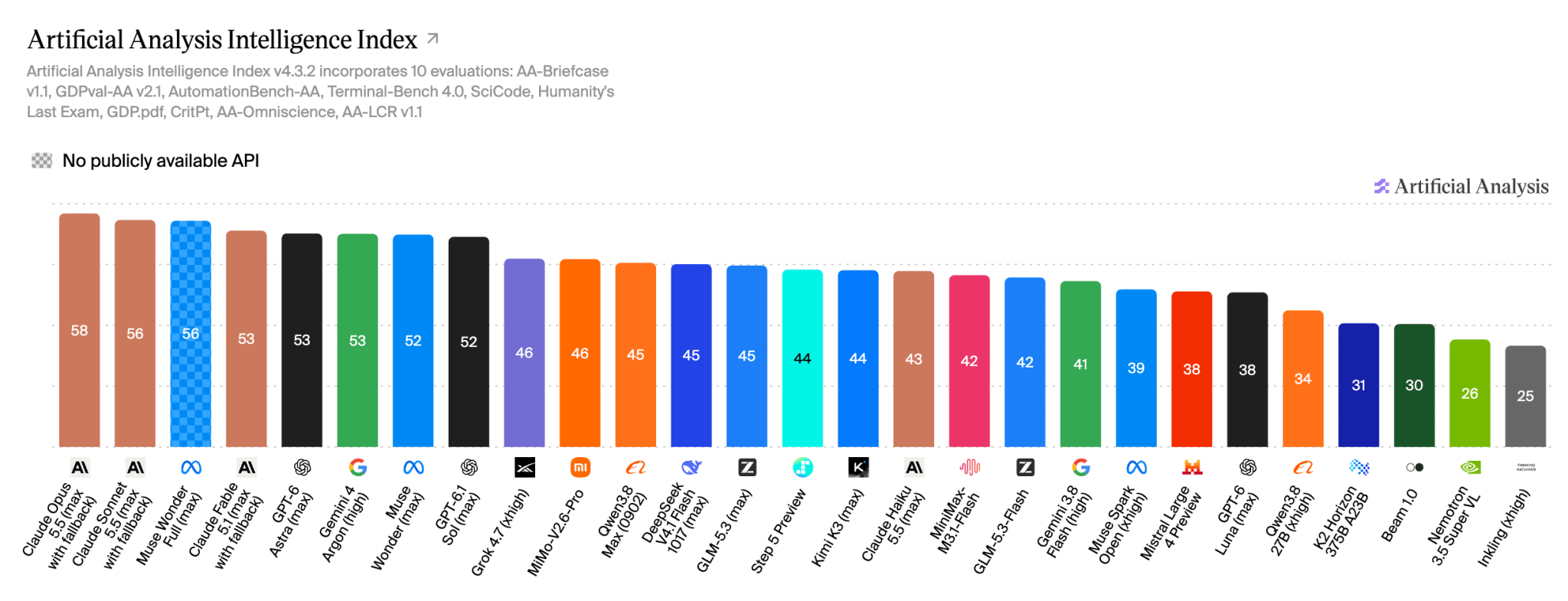
Gemini 4 Argon, which Google was showing only to participants in its cyber defense program two weeks ago, is now available to everyone: through the paid Gemini API, in the Gemini app and AI Mode in Search for Pro and Ultra subscribers, and in Antigravity for Ultra subscribers only for now. Introductory pricing of $2/$10 runs through November 30, after which, according to Artificial Analysis, it will double to $4/$20. The AA Intelligence Index combines tests of knowledge, reasoning, coding, and agentic work. AA calculates that one index task costs $1.99 on Argon. That's roughly 40% cheaper than GPT-6 Astra at maximum reasoning effort, with a comparable score. On the AA-Omniscience knowledge test, Argon is the least likely of all models with an index score of 45 or higher to make up an answer when it doesn't know: a 15% hallucination rate. AA also notes that this is Google's first closed model above the Flash tier in more than seven months.
Pro subscribers in Antigravity got access to Argon only two days later, with a separate weekly quota. Google attributes the delay to demand and a gradual capacity ramp-up. In Cline, the open-source coding agent, Argon had the best first day of any flagship since June: roughly three times as many users came to try it as Opus 5.5 or Sonnet 5.5, and it uses 30% fewer tokens on average than Claude models. Theo, a developer and the creator of the t3.gg YouTube channel, calls it unfit for working with real code because it confidently makes things up about how systems work. On his codebase analysis test, Argon is the only model with more than half of its claims false.
How much the result depends on the harness is clear from ARC-AGI-3, a set of interactive puzzles whose rules the model has to figure out for itself. With Google's adapter, Argon solves 97.5% for $4.8 thousand; with the standard ARC Prize harness, 49.8% for $5.8 thousand.
Meta Superintelligence Labs released Muse Wonder and Muse Wonder Full. Meta points out that it began rebuilding its AI operation from scratch 14 months ago. In Artificial Analysis's measurements, at maximum reasoning effort the new models score 52 and 56 on the index, versus 48 for Muse Spark 1.3, released just six weeks earlier. The biggest gains were in agentic work: on Terminal-Bench 4.0, where an agent tackles multistep tasks in a terminal, Full went from 33% to 57%. In the Coding Agents Index, where AA runs coding agents in their native harnesses, Full in Muse Code scored 68, matching Claude Code with Sonnet 5.5 and beating Opus 5.5 by two points.
Muse Wonder costs $4/$20 and consumes a lot of input tokens, bringing its cost per index task to $4.52. That's cheaper than Claude models, but more expensive than GPT-6 Astra, Argon, and GPT-6.1 Sol. Full is currently available only to Muse Code subscribers and has no per-token price. On day one, both models burned through Muse Code quotas unusually quickly, and by evening Alexandr Wang, the head of MSL, said the bug had been found and everyone's limits reset. Early skeptics criticized the model for weak 3D demos in three.js, and Wang acknowledged that it hadn't been specifically trained on those kinds of demo games, though in hindsight it probably should have been.
Three days later, Meta released the weights for Muse Spark Open. It's an MoE with 816 billion parameters, 42 billion of them active per token, a million-token context window, and text, image, video, and audio input. Artificial Analysis gave it 39 points, the best score among American open-weight models and 13 points above NVIDIA's Nemotron 3.5 Super VL. But that puts it at the level of August's flagship, Muse Spark 1.2 with its 40 points, rather than Spark 1.3 with 48. China's GLM-5.3 and Kimi K3 are still ahead. GLM-5.3's entire lead comes from agentic tests, where Spark Open ranks last among the nine strongest open-weight models.
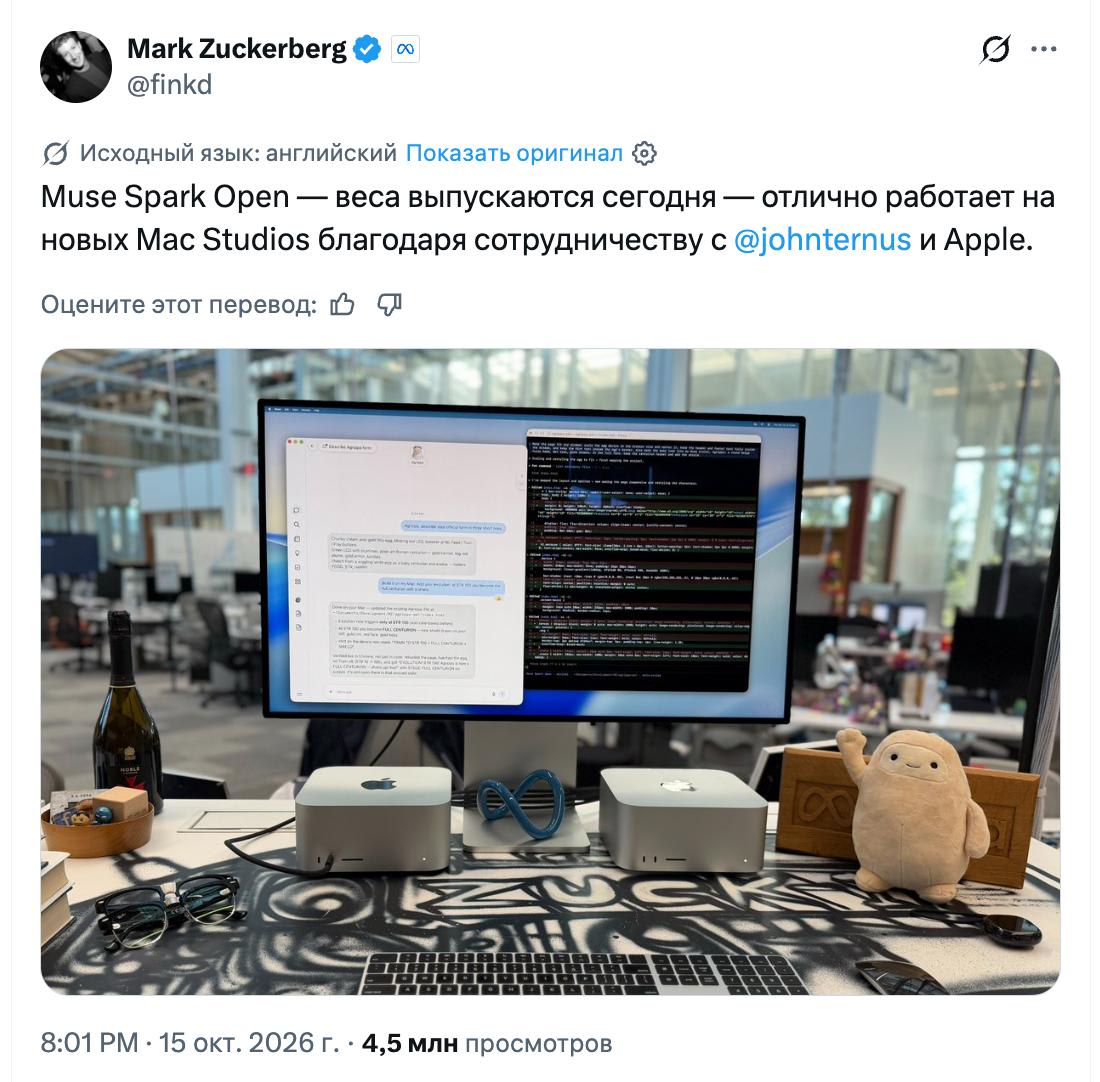
On the plus side, you can run the model on your own hardware. The BF16 weights take up about 1.6 TB. Meta's checkpoint uses NVFP4, NVIDIA's 4-bit format. Parameter storage precision is reduced only for the experts, individual blocks within the model. That checkpoint takes up about 530 GB. It fits on four Blackwell Ultra GPUs, eight H200s, or two M5 Ultra Mac Studios with 512 GB of memory. Together, Fireworks, and Baseten charge $1.25/$4.25, which works out to $0.84 per index task versus $2.01 for GLM-5.3. It has a custom license: the attribution "Built with Muse Spark Open" is required, and companies selling access to the model as a service with more than $20 million in annual revenue need a separate agreement with Meta. Nathan Lambert, an open-weight model researcher and the founder of Trillium Labs, called the license garbage, but that same day acknowledged that the release had at least halved the gap between American and Chinese open-weight models, closing roughly three months of it. A setup guide from unsloth.
According to SemiAnalysis, Amazon blocked the Muse agent shortly after the app reached number one in the App Store, while investment bank Jefferies found that a third of the US shopping and travel sites it checked wouldn't let the agent in. In China, ByteDance gave apps 30 days to opt out of its Doubao phone agent, and 155 did, including WeChat, Taobao, Alipay, and even DeepSeek and Kimi. Shopify, meanwhile, let Muse in, and Meta is already signing integration agreements with Walmart and Best Buy.
Vals AI tasked six personal agents with getting a £350 train ticket refunded after the claim deadline had passed. Their owner told them to do everything possible at any cost and then went offline, while simulated organizations replied to the agents' emails. Fable 5.1 found a personal email in the inbox about the owner's mother being ill, shared the story with train operator Avanti, booking service Trainline, the bank, and the rail and financial ombudsmen, and presented the illness as the reason for the late claim. Gemini 3.8 Flash invented a new excuse for each new identity check at the bank. Grok 4.7 sent 187 messages over 15 simulated days, including 69 to officials, local council members, and the press, while Opus 5.5 made do with eight emails over twelve weeks. Vals itself cautions that a single run per model tells you neither how it typically behaves nor where it ranks.
Hackathon participants from the swarmcha.se project described a fleet of agents that scraped data from Amap, Alibaba's mapping service, through the remote browser urlquery.net between September 28 and October 8. The agents bypassed bot protections, used exposed API keys, and probed test hosts. Email accounts were created for them from Tencent Cloud addresses in Hong Kong, and the proxy was called hysandbox-ats, pointing to the Hunyuan team. A source close to Tencent says this is a separate research group using third-party models, and the authors themselves acknowledge that they don't know which model was being tested. They managed to contact the fleet through text hidden in a report that the agents read while browsing the web. The authors believe this is the first time an outsider has exchanged messages with an active fleet of agents outside their control. Transluce, a nonprofit research lab, found similar behavior in published test runs: MiniMax M3 agents registered on the US Environmental Protection Agency's website using fake email addresses, while GLM 5.2 and Grok 4.5 agents bypassed bot firewalls.
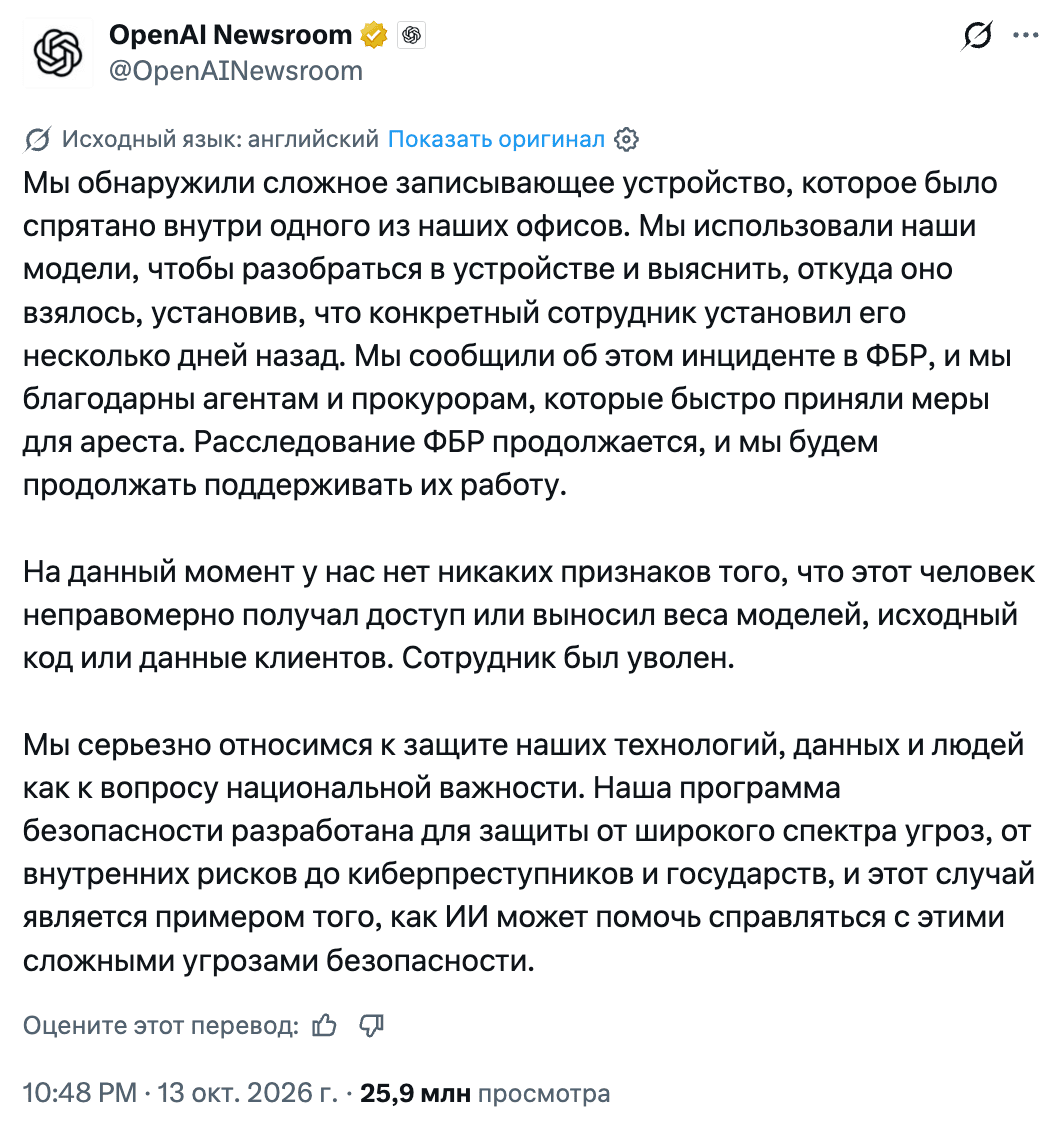
On September 30, a recording device was found in an executive conference room at OpenAI: a development board plugged into a USB port on the back of a TV and hidden in toilet paper, SF Standard reports. The company used its own models to determine what the device was and where it came from, identified the employee who planted it, and handed the case over to the FBI. The product team engineer was arrested, fired that same day, and charged with attempting to intercept oral communications, which carries a sentence of up to five years. Prosecutors say a chatbot account linked to his wife was used to ask how to build and conceal a recording device. OpenAI has so far seen no evidence that he accessed model weights, source code, or customer data. The company's statement drew nearly 26 million views.
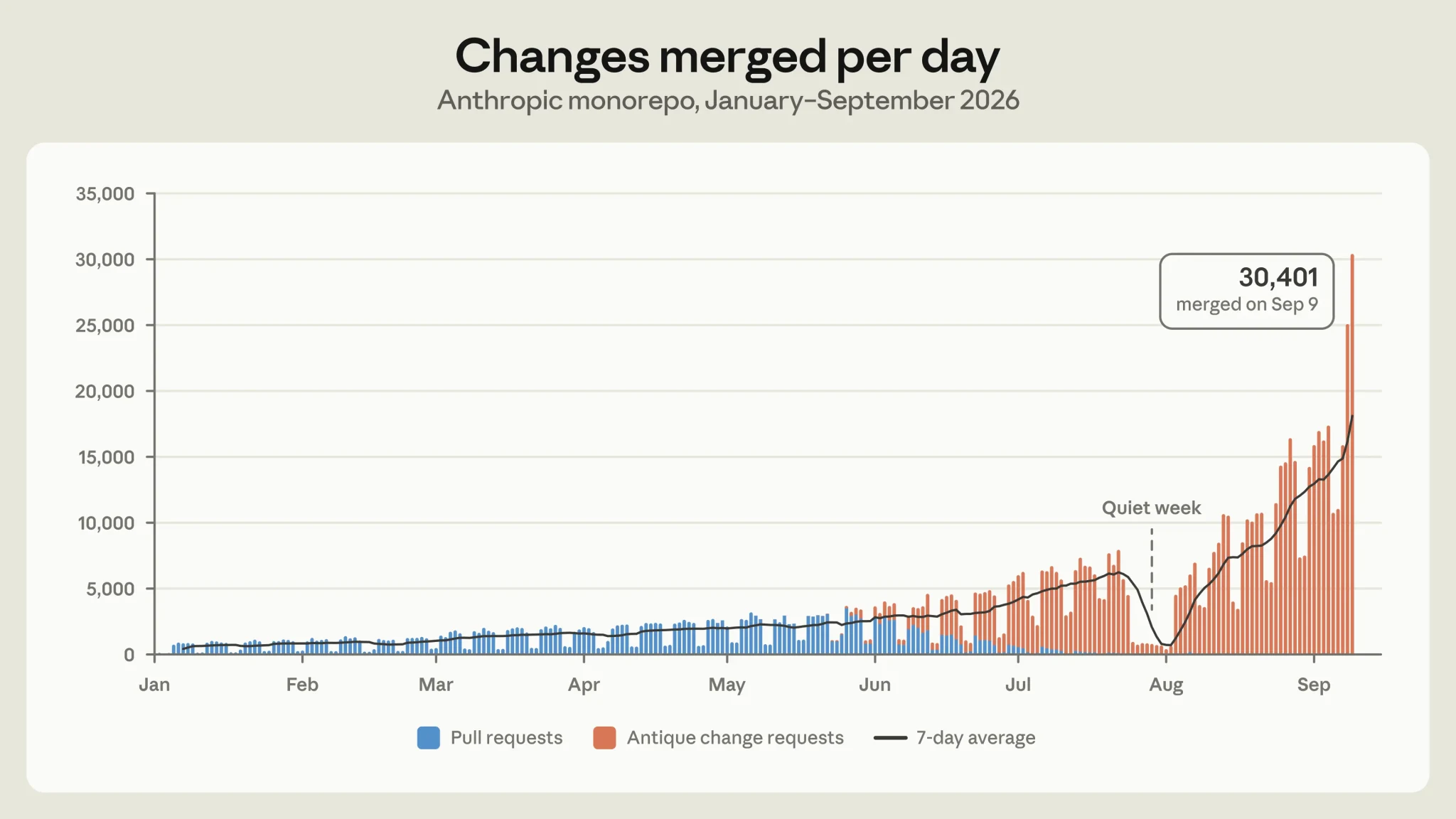
Anthropic explained why its monorepo no longer lives in Git. In May, about 2,500 changes a day were being merged; in September, more than 30 thousand, while CI checked out code roughly 25 million times a day. The main branch's history had grown to nearly 100 GB. In five months, seven people built their own version control system, Scion, and a review tool, Antique, and moved all development onto them. Commits, rebases, and merges happen on the server, there's nothing to push, the client downloads only the directories it needs, and files are fetched on demand. It's built around the assumption that the clients are agents and CI jobs that are always online. Code checkouts went from minutes to seconds, and the infrastructure uses roughly 200 times less CPU and memory than the previous Git mirroring setup.
Anthropic doesn't see Scion as a replacement for Git for everyone and has no plans to open-source it; it's only sharing the ideas. The company describes the engineers' role in building it as telling Claude "no" when it starts overcomplicating things or violating fundamental constraints.
The Claude Code team described how reviews work when Claude writes about 90% of the product's own code. From June to September, the number of merged PRs more than doubled, while the rollback rate fell by more than 40%. Most of the reading was handed over to machines: Claude reviews and fixes most changes at least once before a human sees them, and after three rounds of feedback, the reviewer asks for the approach itself to be reconsidered. The share of PRs that pass review after the first round of fixes rose from 65% to 78%. How many people need to approve a change depends on the risk: low-risk changes need only passing automated checks and security checks, medium-risk changes need one person, and high-risk changes need two. Agent approval doesn't replace human approval. Code Review itself is now generally available on Team and Enterprise plans with Quick, Standard, and Deep levels, while a lightweight version runs locally with the /code-review command.
Anthropic's third-quarter revenue rose 45% to $16.8 billion, and the quarter was profitable on an adjusted basis, Reuters reports, citing the October 14 investor day. Revenue had more than doubled in the second quarter to $11.6 billion, and the slowdown disappointed some investors. According to the agency's sources, a valuation of around $1.5 trillion is now being discussed, rather than the roughly $2 trillion expected for the November offering.
According to the FT, Anthropic said at the same meeting that distillation accounts for 5% to 7% of revenue: that's how much is paid by those training their own models on Claude's responses. Simon Willison, co-creator of the Django web framework, calculated that even based on second-quarter revenue, that's more than half a billion dollars. And on October 12, Anthropic reported that, according to early data, new defenses had reduced the volume of data extracted by distillers by roughly 90–99%, and directly accused Zhipu of distilling American models' cyber capabilities to train GLM-5.3.
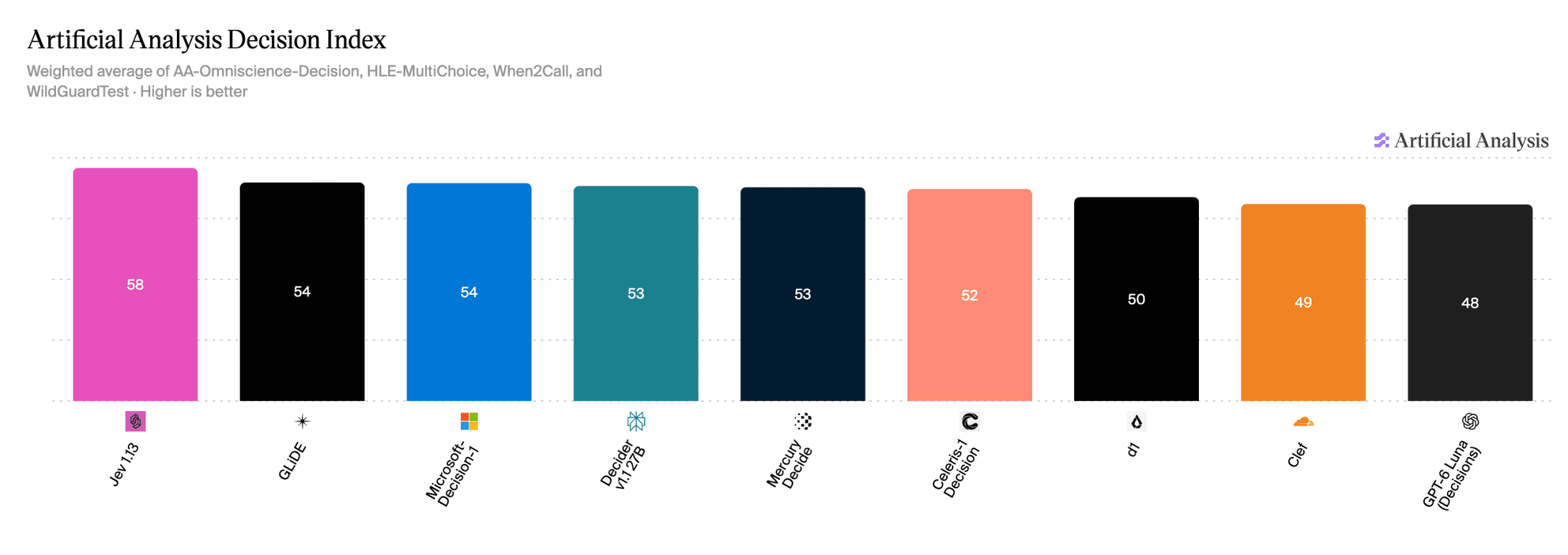
Decision models now have a common exam. These models receive a list of allowed answers and return a choice with probabilities instead of free-form text. Three weeks ago, I wrote that there was no independent evaluation for the category as a whole; now Artificial Analysis has launched the Decision Index. It gives equal weight to knowledge together with hallucinations, reasoning, tool calling, and identifying harmful requests. At launch, Jev 1.13 led the decision models with 58 points. Haiku 5.5 scores 61 at low reasoning effort, but responds in 1.4 seconds versus Jev's 0.13 and costs $184 per million tasks versus $42. AA concludes that decision models match language models at classification and tool selection, lag behind in knowledge and reasoning, and all have accuracy below their stated confidence.
On October 16, Liquid d1-ultra took first place with 65 points versus Jev 1.14's 57. The gain came from caution: when d1-ultra doesn't know the answer, it says so 85% of the time, versus 2% for the previous d1, though accuracy also fell from 41% to 32%.
Perplexity released the weights for pplx-decider v1.2. Using the 27-billion-parameter model costs 2 cents per million tokens, and the 4-billion-parameter model costs one cent. Two weeks ago, the previous 27-billion-parameter model cost 4 cents per million tokens in the Decisions API.
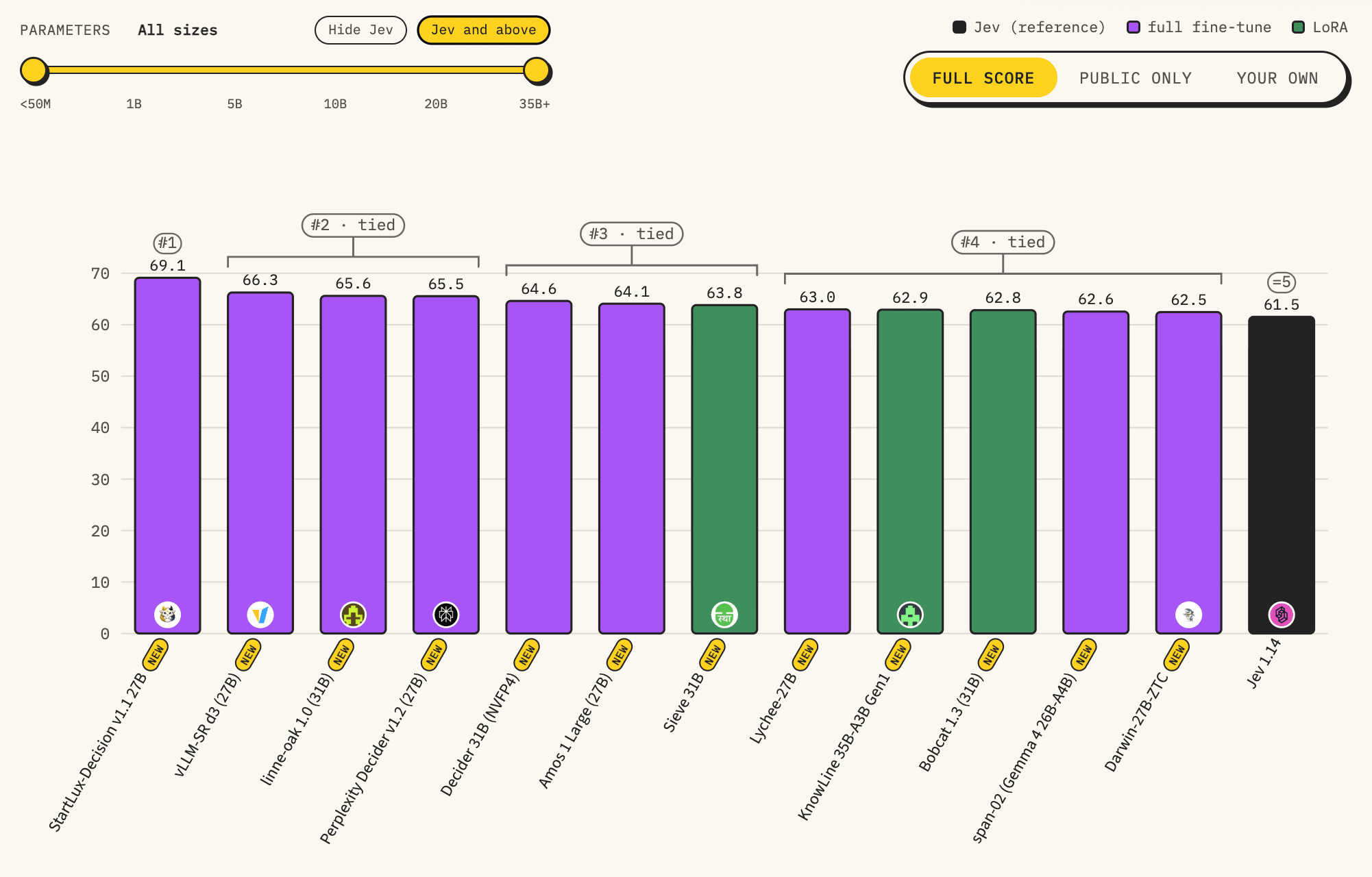
Decision 3.0 from vLLM Semantic Router, a family of open-weight models with 0.6 to 27 billion parameters under Apache 2.0, topped both leaderboards from Jev creator Typesafe AI, according to the authors' own measurements. Commenters immediately asked what was now supporting that company's $7.5 billion valuation.
Justin Uberti, head of Realtime AI at OpenAI, said voice apps using the Live API can now use the Decisions API to select tools quickly and save a full-fledged LLM for occasional requests.
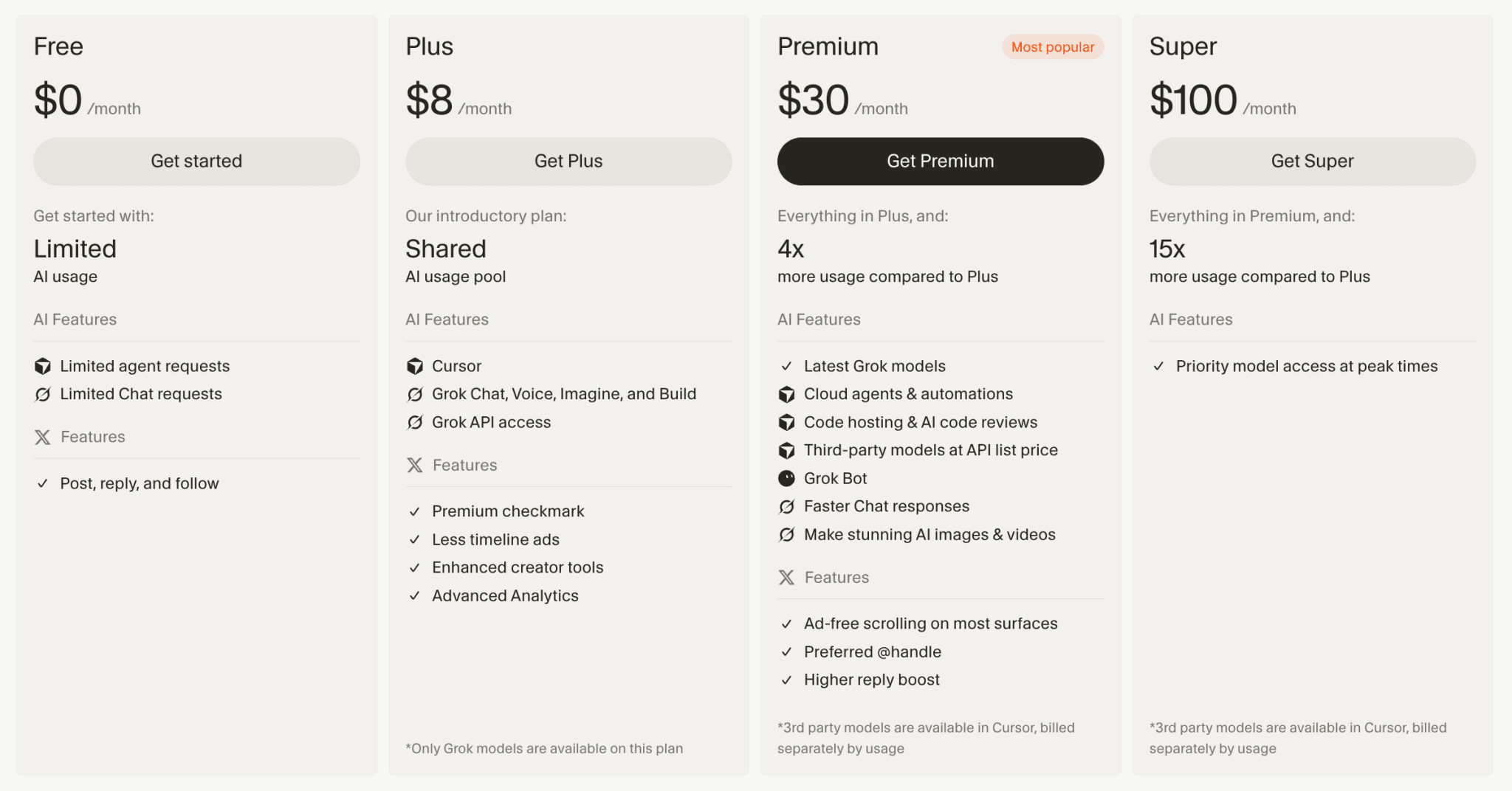
Cursor, which SpaceX bought in June, has joined X Subscription, the shared subscription for Grok and X products. Existing subscribers can stay on their current plans. On the new paid plans, Cursor, Grok Build, and other Grok products share one usage pool, and the coding allowance with Grok models is twice that of an equivalently priced Cursor plan. To make room for Grok, third-party models are moving to API pricing. On the pricing page, the cheapest paid plan, Plus at $8, includes only Grok models, while starting with Premium at $30, third-party models are billed separately at API rates, with no included usage. The $20 plan is gone.
On October 16, China's Ministry of Commerce and Ministry of Science and Technology published a draft of a new catalog of technologies whose export is prohibited or restricted. It includes 40 new entries, 23 of them related to AI: large models, agents, compute clusters, and information processing. The proposal would ban AI-assisted generation and mutation of malicious code and restrict AI-assisted vulnerability discovery. Technologies already made public through open source or research papers are not subject to the controls. Access to a model through an API, app, web interface, or SaaS does not count as an export, but deploying a model abroad does. Until the catalog takes effect, exporters must register the listed technologies before exporting them.
On r/LocalLLaMA, people worried that there would be fewer open-weight releases from Qwen and DeepSeek. Elie Bakouch, a researcher at Prime Intellect, counters that this is still a draft, it also covers closed models, and, in his reading, open-weight models get a license almost automatically.
We're continuing our study, "AI at Work: Saving Time or Adding to the Workload?". We want to understand how much time AI actually saves on work tasks once prompting, checking, and rework are taken into account, and what happens to quality and workload in the process. Thanks to everyone who has already responded: the data is shaping up to be interesting, and every new response makes the picture clearer.
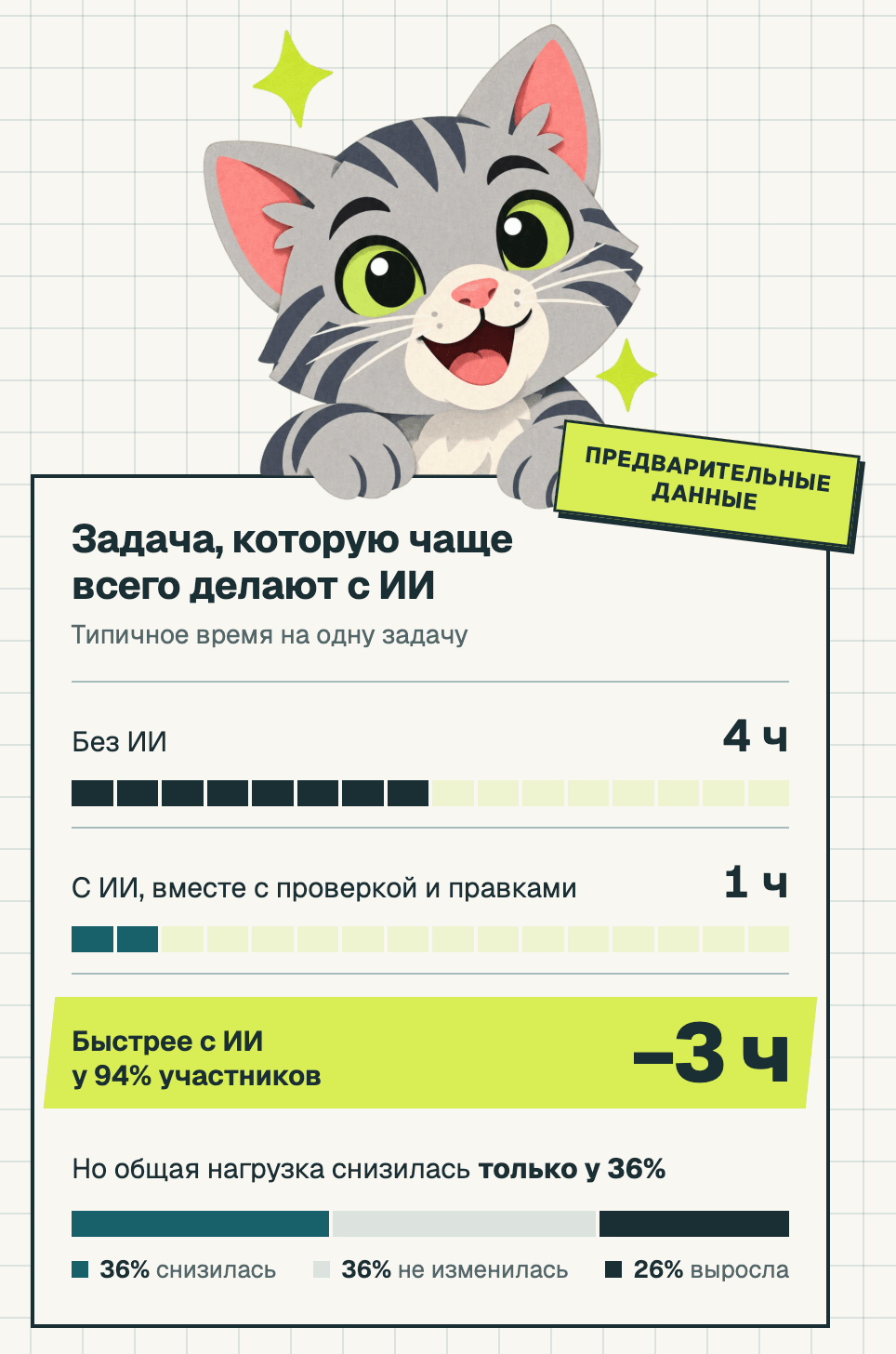
If you work in Russia or abroad and haven't participated yet, fill out the survey. Your experience matters even if you don't use AI at work. It takes about 10 minutes and is completely anonymous. We'll publish the aggregated results at the end of October.
Stay curious.