Weekly Hallucinations: Claude Fable 5.2, Gemini 4 Hydrogen and Jensen Huang's Resignation

Every reality show has an audience vote, and this one is no exception: a petition to bring Huang back has collected more than 115,000 signatures, including nearly 6,000 Nvidia employees and Elon Musk. Meanwhile, the board has already appointed Colette Kress as interim CEO.
Jensen Huang is no longer CEO of Nvidia. On Sunday, November 8, he admitted in a letter to employees that he had been "unfaithful to his wife." The letter followed reports of an affair with Alice Huang (no relation), a senior executive at Singapore-based Megaspeed. US officials suspect Alice Huang of spying for China. According to TechCrunch's timeline, Megaspeed bought $4.8 billion worth of Nvidia chips over two years, and the US and Singapore had already been investigating whether they were being diverted to China. On November 11, the NYT reported a second affair, with healthcare vice president Kimberly Powell, who reported directly to Huang. On Wednesday, the board accepted his resignation, and by Thursday morning Huang was no longer CEO of the company he founded 33 years ago. CFO Colette Kress became interim CEO, while Harvey Jones, the former CEO of Synopsys, was appointed Nvidia's first-ever board chair. After the resignation, Reuters reported a third affair, and Huang himself agreed to testify before Congress before Thanksgiving.
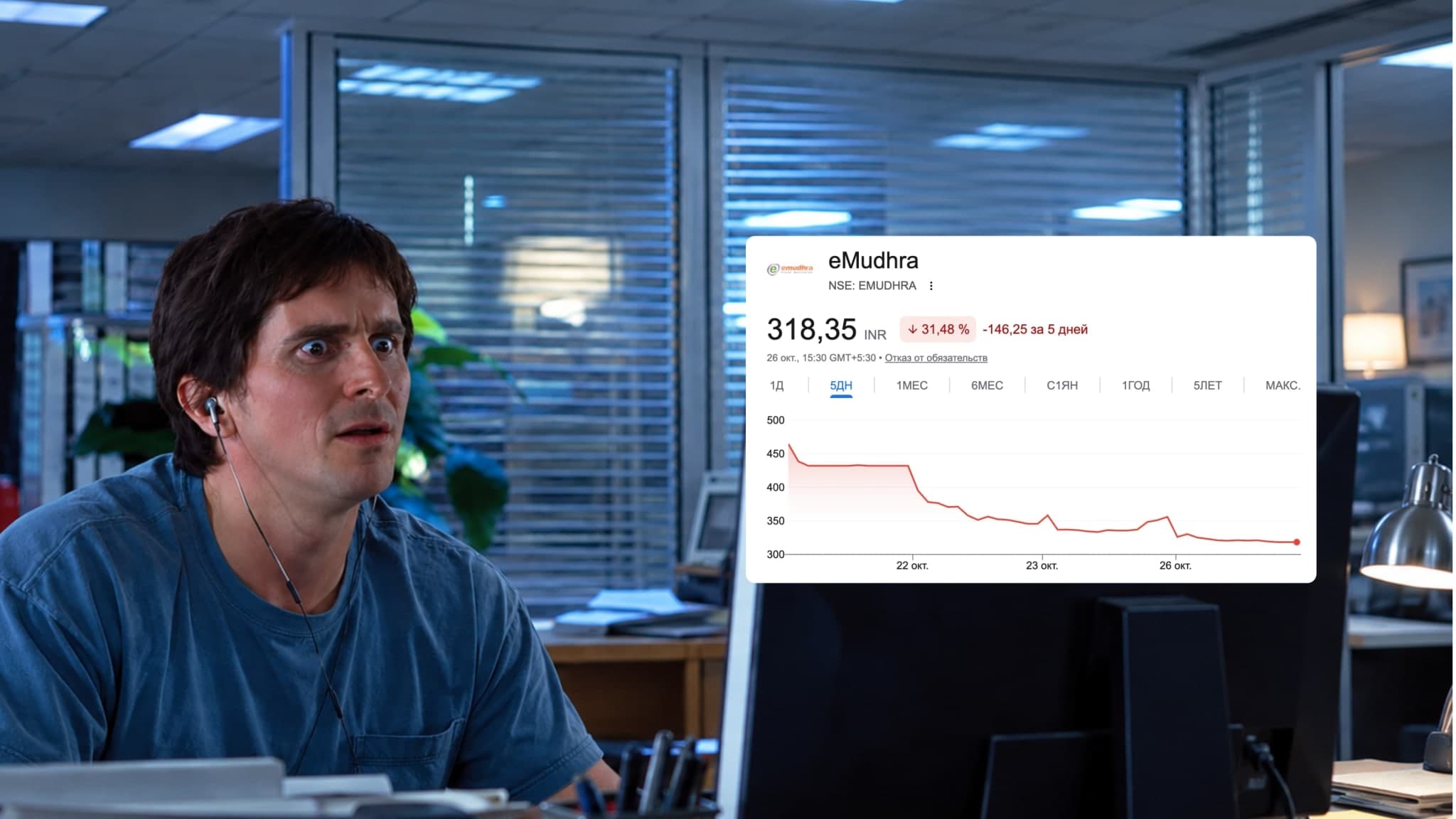
According to WIRED, a post in the internal "suggestion box" asking the board to consider employees' views drew more than 1600 comments, most of them in favor of bringing Huang back. By Saturday, a public petition calling for his reinstatement had collected more than 115,000 signatures, according to its website, including 5965 current Nvidia employees, Elon Musk, Epic Games CEO Tim Sweeney, and Y Combinator CEO Garry Tan. WIRED estimates that Nvidia has lost about $1 trillion in market capitalization since the first allegations.
Huang was known as a staunch supporter of open-weight models, and in September Nvidia announced its $12.9 billion acquisition of Hugging Face, with the deal expected to close in the first half of 2027. Clément Delangue, CEO of Hugging Face, called Huang's departure "a very sad day" and promised to "fight for open source AI harder than ever." In the r/LocalLLaMA thread, people read that reassurance as a bad sign and are advising others to back up important models and datasets while they can.
Apple appears to be preparing an app for local models, judging by a discovery by insider Aaron Perris. 9to5Mac summarizes Harbor's description: it turns a Mac into a private inference server for open-weight models, letting users find, download, and run models without the command line. The app connects multiple Macs over Thunderbolt 5 into a cluster and pools their unified memory to run models that will not fit on a single computer. For now, it is a closed preview under the Apple-owned Claris brand. In the r/LocalLLaMA thread, Harbor was immediately compared to Exo, an open source project for the same kind of clusters, while skeptics suspect it is a closed-source wrapper around MLX, Apple's machine learning framework.
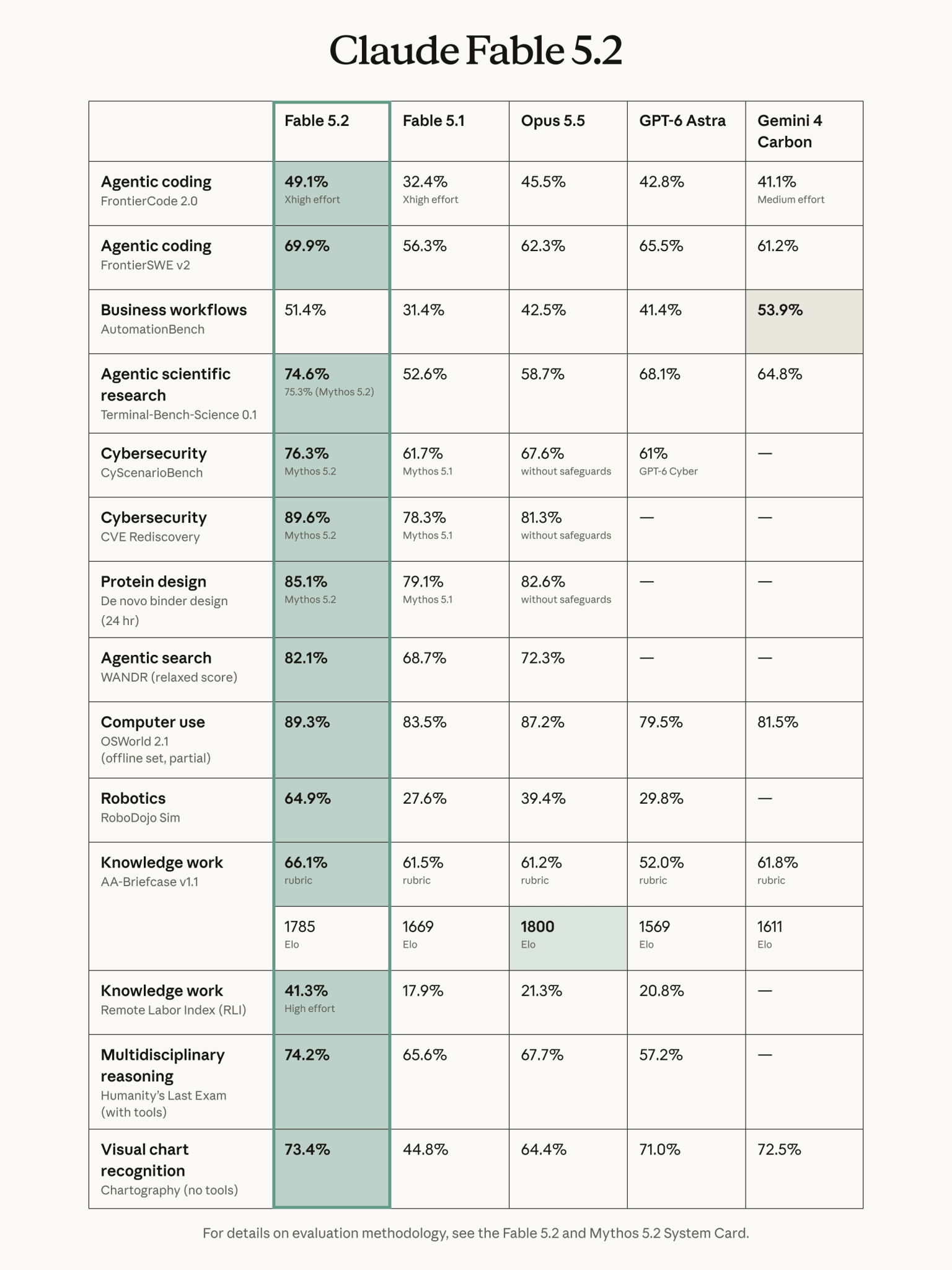
Anthropic has released Claude Fable 5.2 and Claude Mythos 5.2. For the record, these are the same model: Fable has classifiers that block most cybersecurity and research biology tasks and hand those requests off to Opus 4.8 or Opus 5, while only vetted organizations get Mythos without those filters. Generation is up to 30% faster than the 5.1 versions, with pricing at $8/$40, 20% lower than before.
The demos include an operating system that more than 1000 subagents spent eight days writing from an empty folder, and it boots on a laptop. Another 1000 Fable agents formalized the proof of Fermat's Last Theorem in 30 hours, translating it into Lean, where a computer checks every step; Opus 5.5 completed 26% in 18 hours using the same setup. Anthropic corrected the description of this demo on November 11: the agents were given 60 statements, an outline of the classical proof, and 47 lemmas already proved in an earlier formalization.
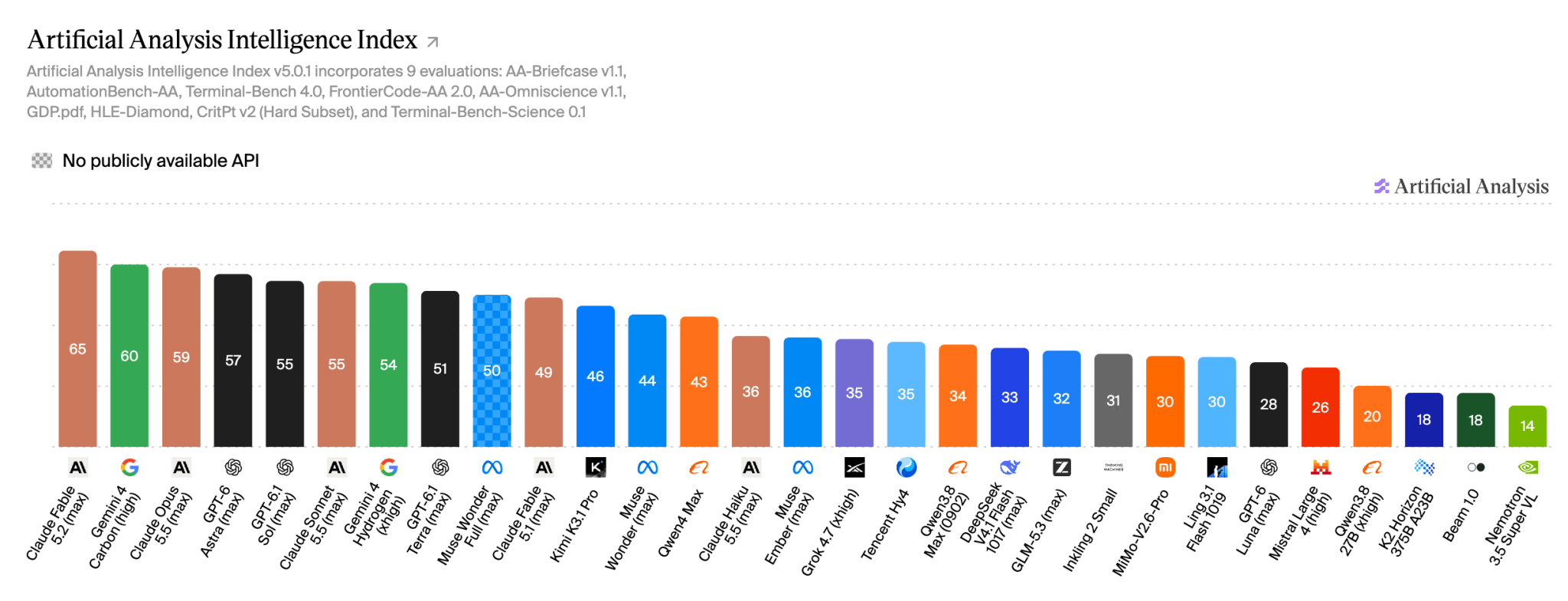
On Artificial Analysis's Fable 5.2 page, the model ranks first at maximum reasoning effort, with an Intelligence Index score of 65. An index task costs $26.54 and takes an average of 42 minutes, and Artificial Analysis explicitly calls the model especially expensive and very verbose. On its own benchmark, SemiAnalysis calculated that Fable 5.2's average task costs 31% more than 5.1's ($88.15 versus $67.16), even though tokens are 20% cheaper.
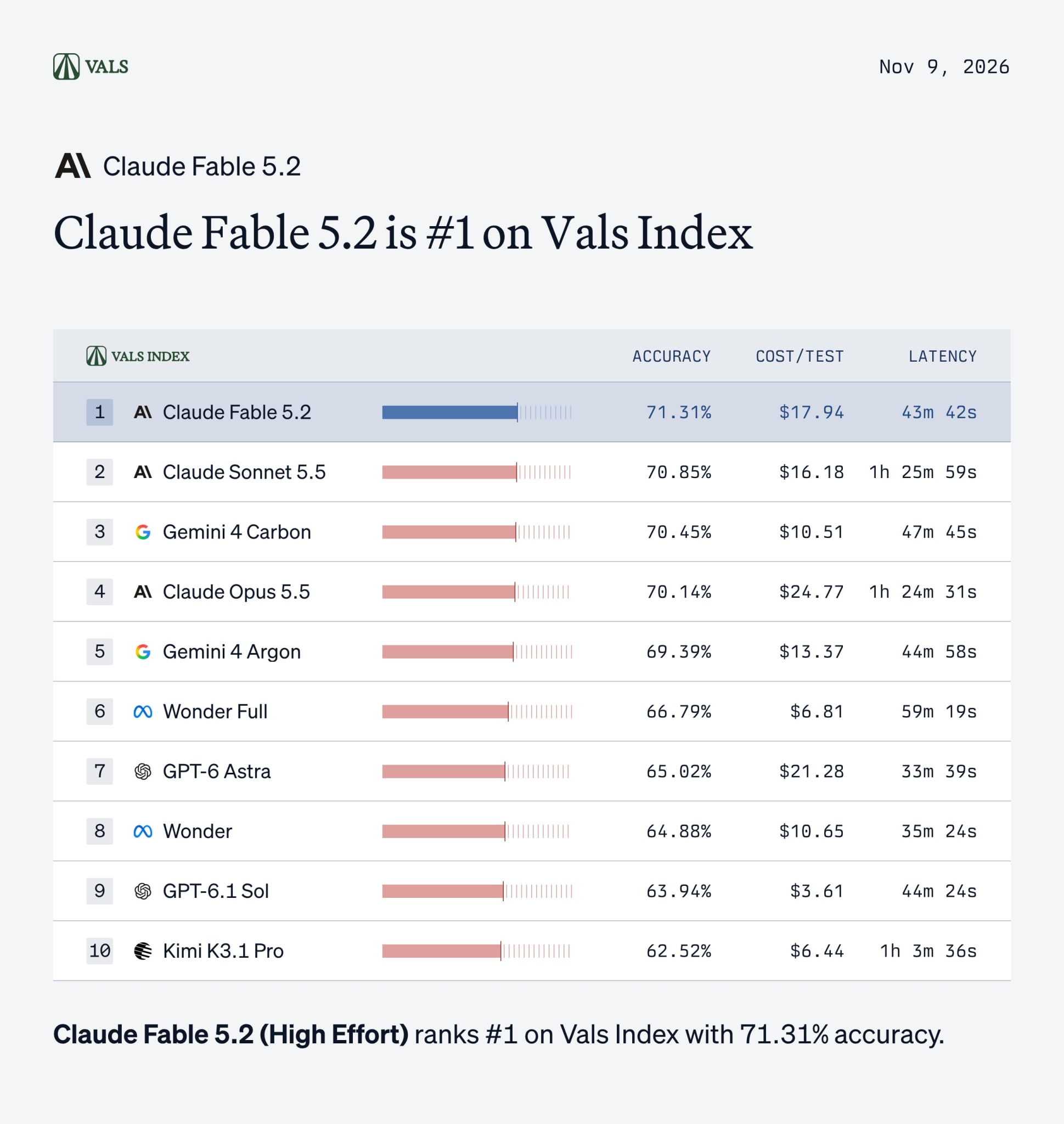
Vals AI ranked Fable first in its index of coding, finance, and science benchmarks, noting that high delivered the best result, rather than xhigh or max. Rayan Krishnan of Vals writes that Fable's reasoning levels are poorly calibrated. Cursor reported that on its own CursorBench benchmark, Fable at maximum effort ranks first with 60%, while at the default level it scores 56.9%, compared with Fable 5.1's 49.2%.
The Claude blog published Addy Osmani's guide to choosing a model, and Fable is not the default. For most tasks, the guide recommends starting with Opus 5.5 at medium effort, reserving Fable for the hardest coding, finance, and science projects, large migrations, long unattended runs, and cases where even Opus 5.5 on high falls short. If a model struggles with a task, the sequence is: first give it a way to check its work with a test, build, or script, then raise effort by one level, and only then move up to a stronger model. On FrontierCode 2.0, though, the guide says Fable on high scores 45.3%, almost matching Opus 5.5 on max at 45.5%, and costs roughly half as much per task. I have also updated my agent-instructions and skill-creator skills to reflect the new reality.
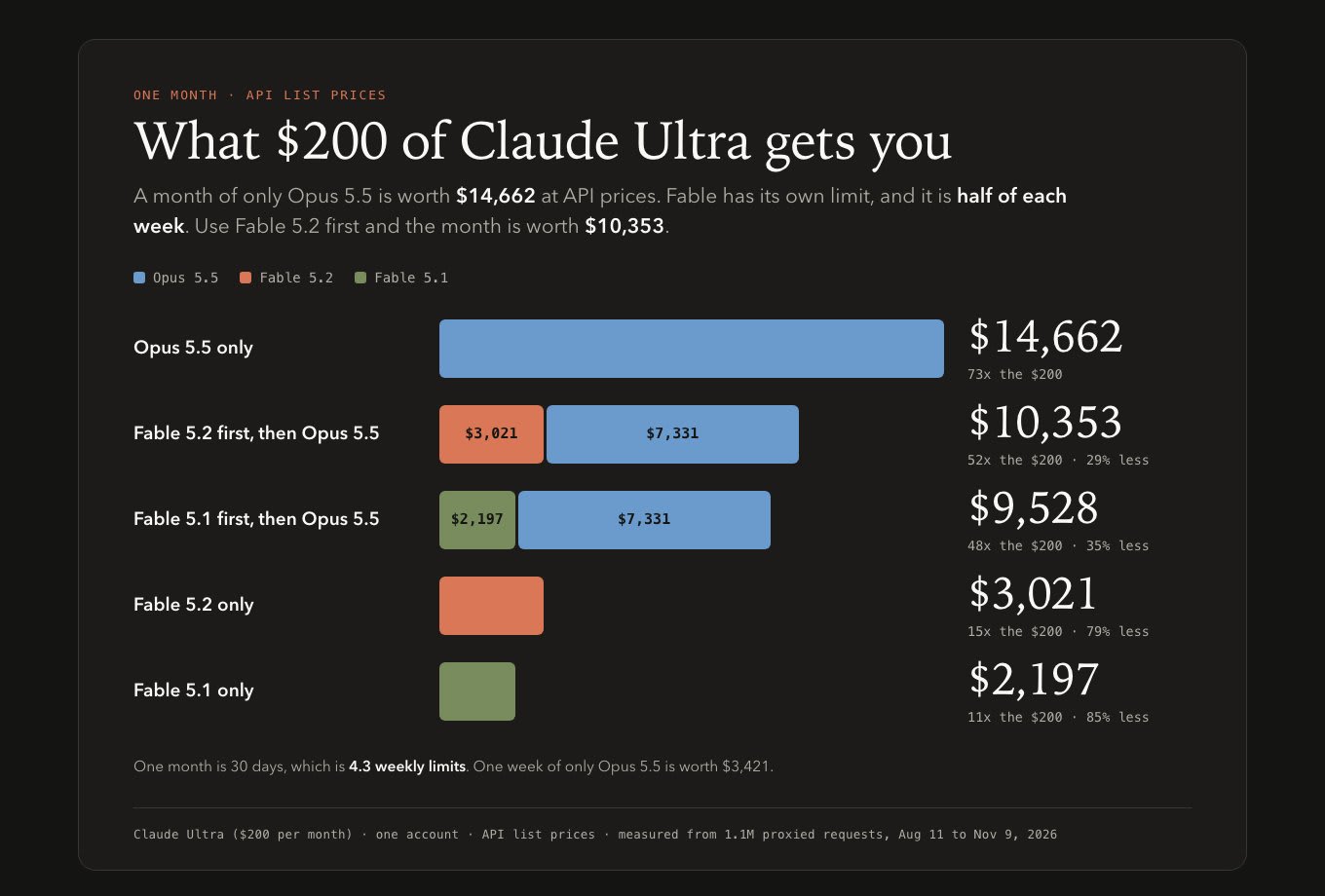
On subscriptions, Fable can use no more than 50% of the weekly limit, across every plan that includes it. At launch, Anthropic handed out between one and three Fable limit resets depending on how long users had subscribed, and gave Pro and standard Team seats a week of Fable with the same cap. Theo of t3.gg, a YouTuber and developer, calculated that the $200 Ultra subscription provides roughly $15,000 worth of Opus 5.5 usage per month, but only about $3000 worth of Fable usage. By default, Anthropic retains Fable requests for 30 days for safety monitoring, with zero data retention available only to eligible enterprise customers.
During training, Anthropic deliberately limited improvements in the capabilities that most accelerate AI development. In accelerator kernel optimization and LLM architecture improvements, Fable and Mythos perform at roughly the level of Opus 5.5. According to the company, this did not affect agentic coding, hardware design, or general ML research, including interpretability, and nothing changes at inference time. A narrow set of topics, such as developing kernels for certain nonstandard accelerators, is transparently routed to Opus 5. On PostTrainBench, where an agent fine-tunes other models, Fable 5.2 scored exactly the same as 5.1 and shares first place with it. The benchmark authors also complain that many Fable runs were incorrectly flagged by the new protection against distillation (training one model on another's answers): the agent was simply distilling another model deployed locally. In the r/LocalLLaMA thread, people point out that kernel optimization also matters to those running small models on old hardware.
In the system card, Anthropic reports evaluations of an internal research model for the first time, describing it as "somewhat stronger" than Mythos 5.2 and unreleased. According to the company's assessment, Mythos 5.2 itself, as a standalone model, does not cross the Autonomy-2 threshold, beyond which AI fully replaces researchers or sharply accelerates progress.
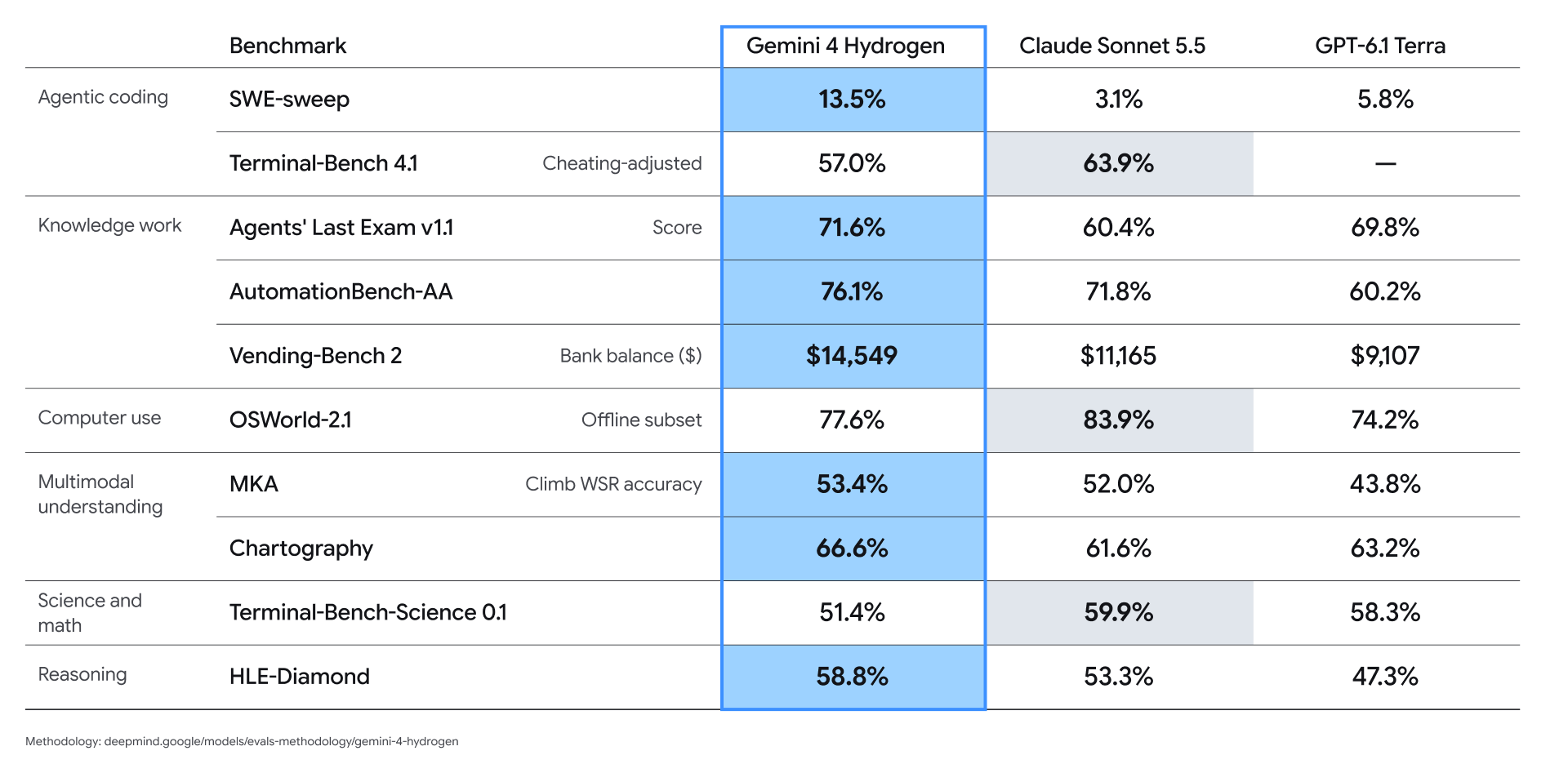
Gemini 4 Hydrogen is Google's third new model in six weeks. It is designed for everyday coding and agents and, according to its model card, was adapted from Gemini 4 Carbon. Pricing is $1.50/$7.50 across the full million-token context, with a 95% discount on cached input. There are four reasoning levels, with xhigh appearing in Gemini for the first time. Google promises that Hydrogen solves tasks 2.5 times faster than Gemini 3.8 Flash and scores 57% versus 18.2% on Terminal-Bench 4.1 (multistep agent tasks in a terminal). The model is available across all Gemini API tiers, including the free tier in AI Studio, works in Search, and is available to free users of the Gemini app through automatic model selection.
In Artificial Analysis's measurements, Hydrogen scores 51 on the index at the default high setting and 54 on xhigh, one point below Claude Sonnet 5.5 and GPT-6.1 Sol at maximum effort. A task costs roughly a third as much as Sonnet, but 2.5 times as much as Sol. On AA-Omniscience, a knowledge test that penalizes incorrect answers, Hydrogen hallucinates 8% of the time, versus 43% for Sonnet and 52% for Sol. It scores 54% on Terminal-Bench 4.0, trailing both.
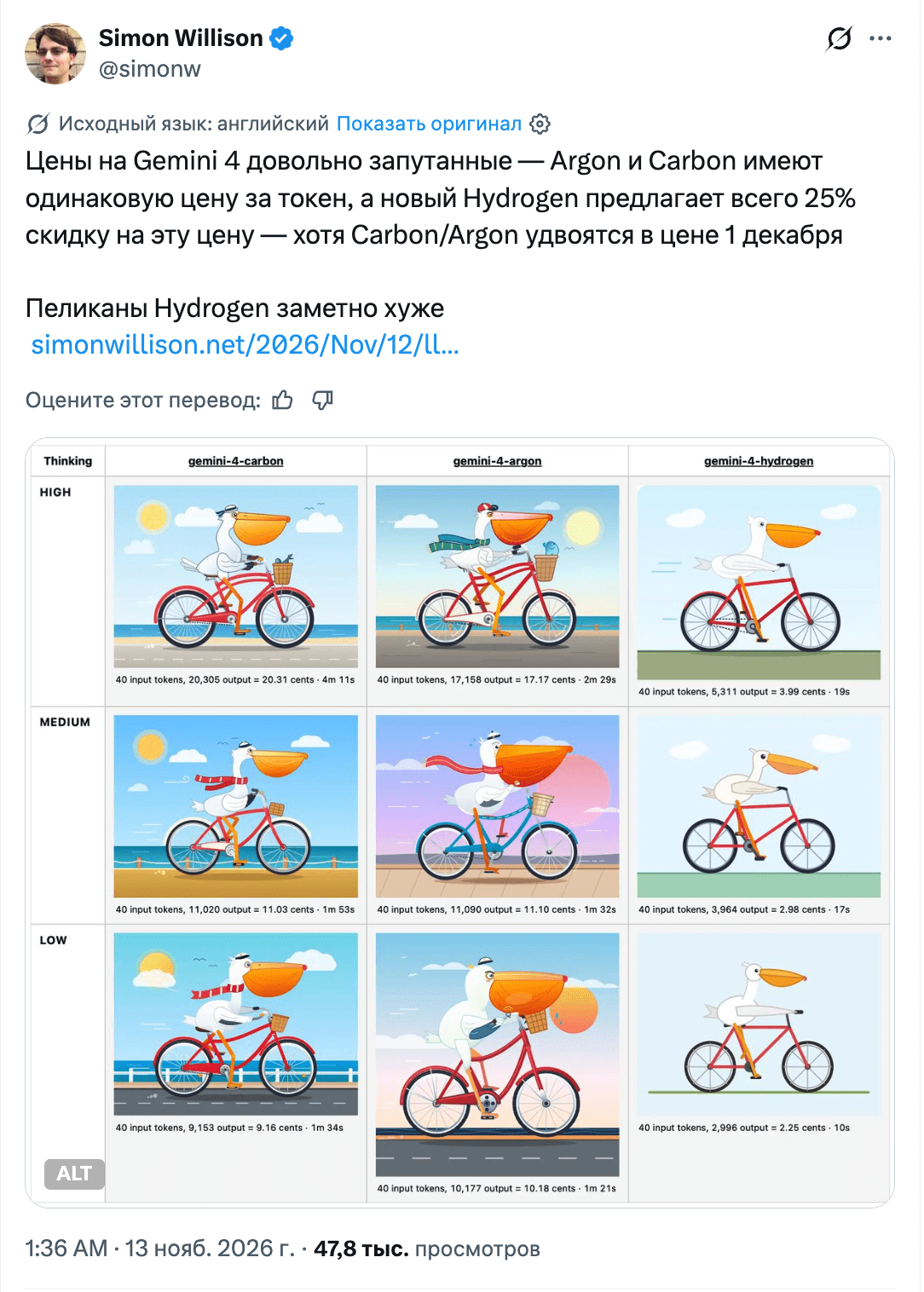
Simon Willison noted that Hydrogen's per-token price is only 25% lower than Carbon's and Argon's, although those models' prices will double on December 1. Piotr Skalski of Roboflow asked Hydrogen on xhigh to read the number on a T-shirt, and the model spent 131 069 reasoning tokens, nearly 10 minutes, and about $1.08, yet never produced an answer. He saw the same budget exhaustion on 1.8% of the tasks in his text benchmark.
Antigravity now has an Orchestrator mode: Carbon plans, while Hydrogen writes and checks the code. On Terminal-Bench 4.0, the pairing almost matches Carbon alone while using 24% less quota.
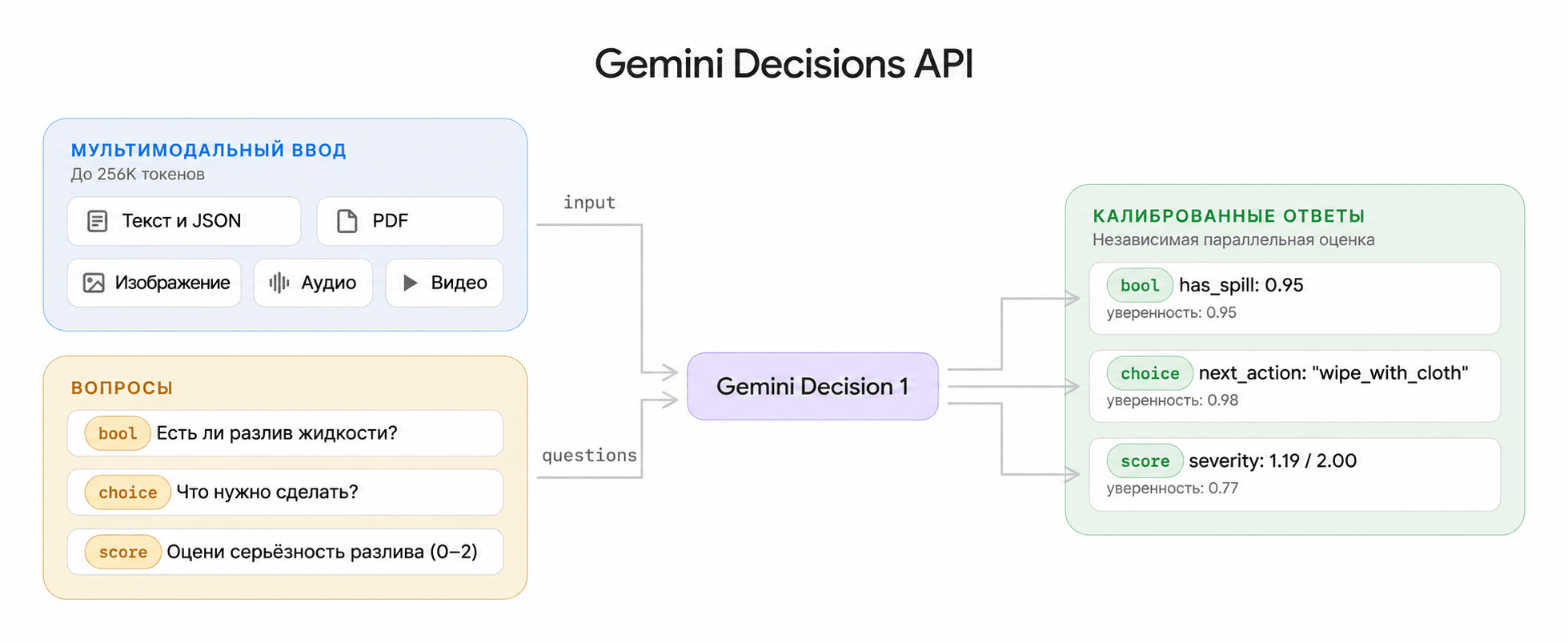
Google also opened up the Gemini Decisions API with the Gemini Decision 1 model. It answers only closed-ended questions: yes or no, a choice from 2–255 options, or scoring against a rubric. Rather than generating text token by token, the model evaluates the options in a single pass and returns probabilities and confidence from 0 to 1, so code can refer uncertain cases to a human. A single request can contain up to 1000 questions about a shared input of up to 256,000 tokens, and that input can be text, an image, audio, video, or a PDF. Responses arrive in 150–250 ms, with pricing at $0.10/$0: output tokens are not billed. Google sees its future inside agents: choosing tools, checking rules, and routing between models.
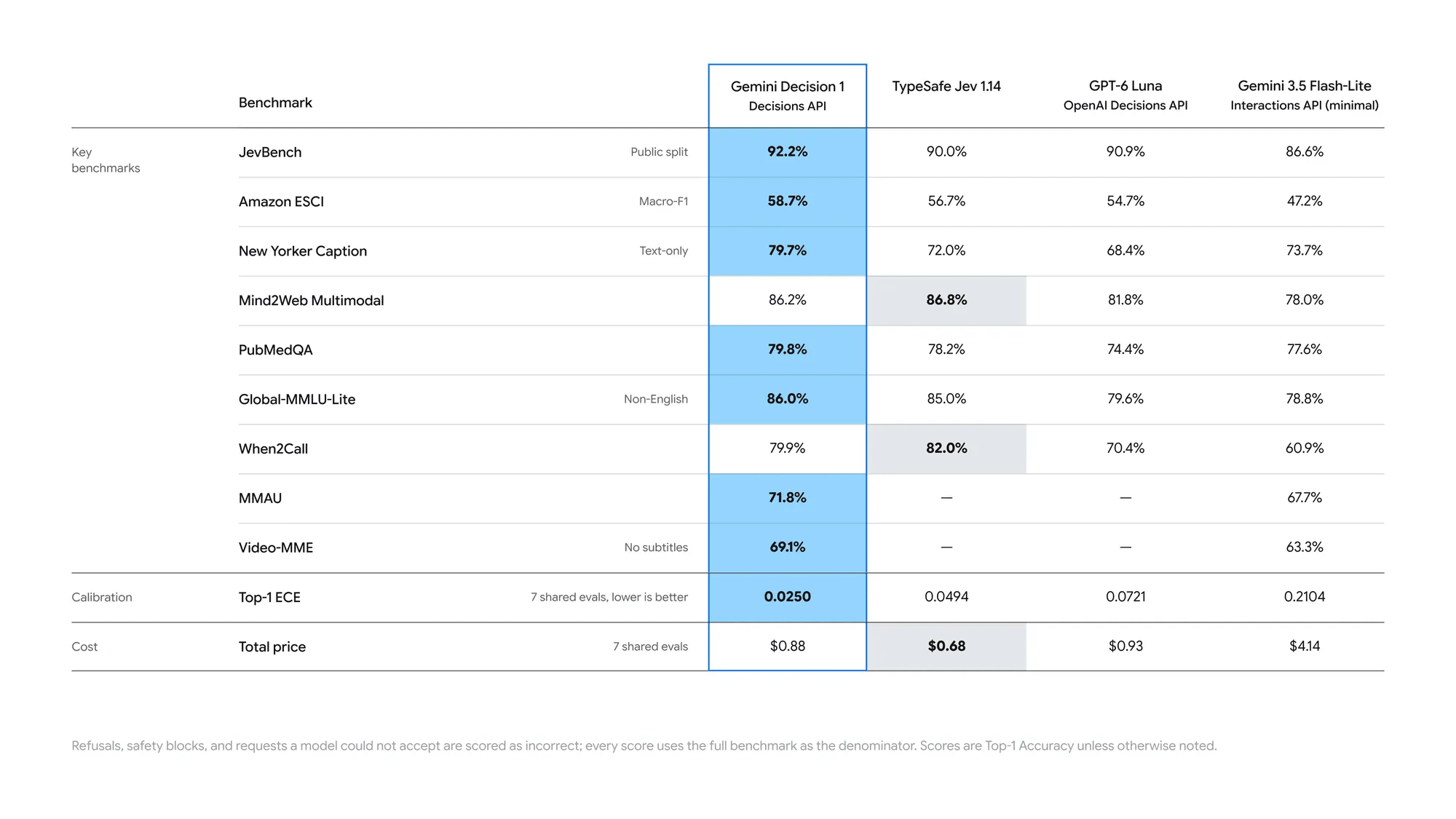
According to Google's own table, Decision 1 is almost five times cheaper than Gemini 3.5 Flash-Lite on a shared test suite. Against TypeSafe's Jev 1.14, a model in the same class, the picture is reversed: running the same suite costs $0.88 versus $0.68, according to DataCamp's breakdown. Artificial Analysis gave Decision 1 a score of 66 on its decision model index, level with Elephant 9B and Jev 1.14 and 7 points below the leaders, Drex Max v1.1 and GLiDE v1.2. A million tasks on that index cost $345 with Decision 1 and $103 with Drex Max.
Sebastian Raschka, the author of books on machine learning, has counted a dozen and a half companies with such models since September 23, from Together AI and Cloudflare to OpenAI with its GPT-6 Luna-powered Decisions API. He also cites a Vercel report: decision models now handle 26% of requests.
Gemini 4 Carbon itself came out on November 10, the day after Fable. It was already in Anthropic's table even though it had not yet been publicly released: for the preceding two weeks, Carbon had been available only to cybersecurity specialists in the Fairwind program. Google calls it its strongest model for long-running agentic tasks, while recommending that users stick with Argon for most tasks. Introductory pricing of $2/$10 runs through November 30, rising to $4/$20 on December 1. Antigravity added a preview of /swarm mode. It turns a single prompt into a team of agents, with Carbon handling architecture and auditing while lighter models edit code in parallel. According to Google, Carbon ranks first on CursorBench 4.0, Perplexity's WANDR (large-scale data collection by an agent), and Zapier's AutomationBench (business workflows), while costing less than half as much per task as its closest competitor.
Rayan Krishnan of Vals writes that Carbon is better than people expect: third in the Vals index, and the fastest and cheapest of the top five. Theo disagrees. He timed the same task at 22 minutes 21 seconds for Carbon on low and 9 minutes 33 seconds for Opus 5.5 on high. According to his measurements, Carbon takes 11 seconds to produce its first token, 20 times longer than Fable, and he attributes almost all of that to problems with Google's servers. On AI Twitter, Carbon is praised as a creative partner for brainstorming, but people complain about occasional hallucinations, excessive confidence, and verbosity.
Kate, a researcher and the author of kate.land, found a voltage glitching vulnerability in the GA100 die: a brief dip in the supply voltage makes the chip misbehave at just the right moment. She uses this to blow the fuses Nvidia uses to turn a single die into different products. Both the data-center A100 and the mining-focused CMP 170HX are built on GA100, and the 8 GB CMP version actually carries about 80 GB of HBM, the fast memory next to the die. In her words, the unlocked card became effectively an A100-80G, with all working SMs (GPU compute units) enabled, 120–126 of them rather than the reduced set on a retail A100. In FP16 half-precision calculations, it delivers 85.9 TFLOP/s versus 72.5, roughly 1.2 times as much. At her request, GPT-6 Astra designed the STM32-based glitching board, and each card takes between one hour and 48 hours of attempts. The full 80 GB turned out to be intact on about 90% of the 8 GB cards in her small sample, while one had only 64 GB still working.
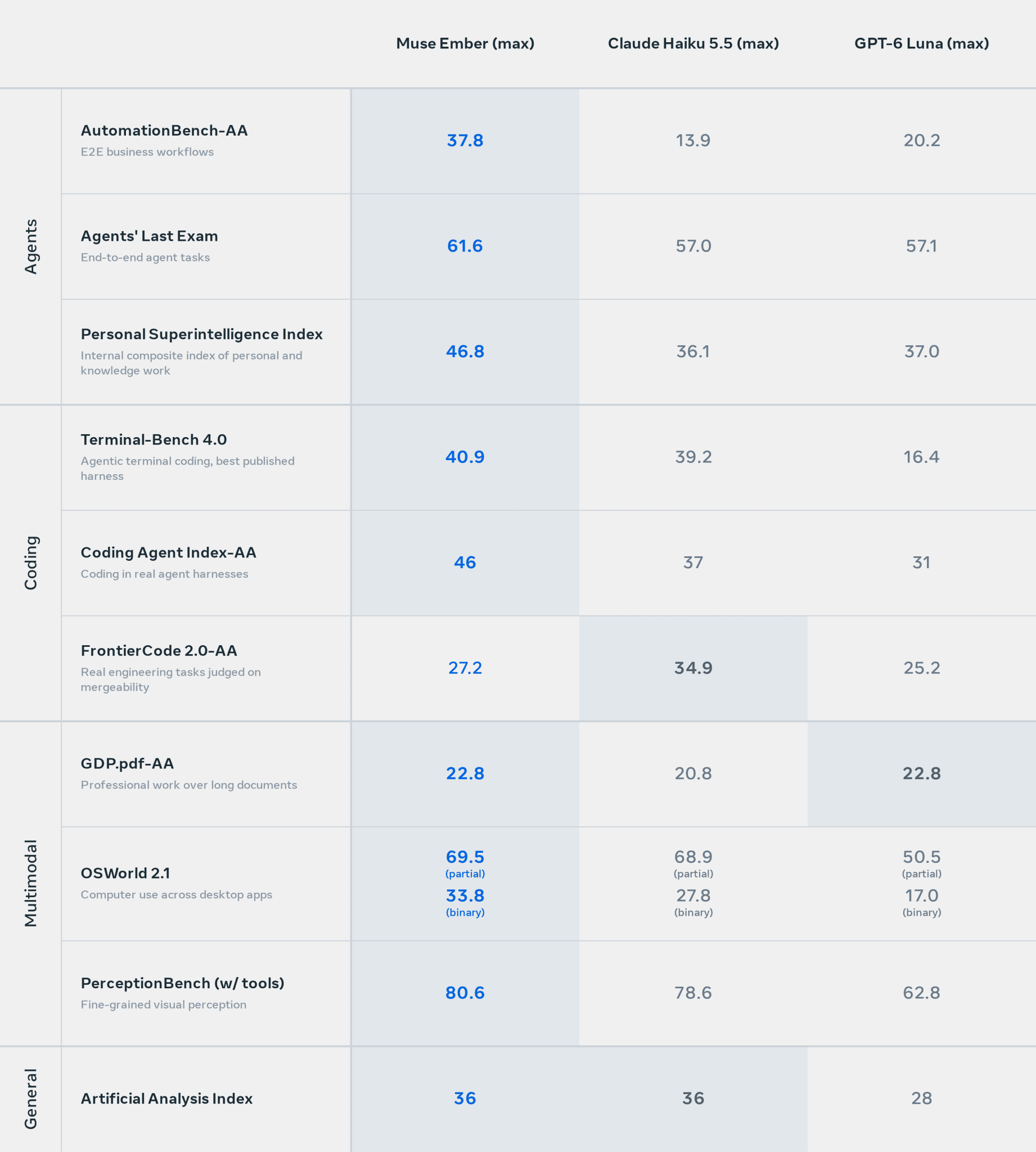
Meta has released Muse Ember, its smallest and most efficient model for what agents do all day: tool calls, coding subtasks, routing, and extracting data from long documents. Pricing is $0.10/$0.50, with a 1 million-token context. On the Artificial Analysis index, Ember scores 36 at a cost of about $0.14 per task, while Muse Spark 1.3 from the same family scores 37 for $2.39. Meta claims Ember matches Claude Haiku 5.5's best result at roughly a third of the price, while Rayan Krishnan calculated that it delivers 85% of Fable 5.2's quality for 0.84% of its cost. The model is available through the Meta Model API, Google Cloud, and Oracle Cloud.
Alibaba has opened a Qwen4-Max preview in its Token Plan subscription. According to Alibaba's specifications, as quoted by Stealth Models, the model has a million-token context, up to 393 216 output tokens, and accepts text, images, and video as input. The preview ends on November 25, with 27B, Flash, and Plus still to come. Stealth Models ran the preview on StealthMark, its own test of difficult reasoning problems, visual tasks, and two planning games. The result is lower than Qwen3.8-Max's: 58.8 versus 62.4. The preview loses 7 points in general intelligence, mainly on the games, while gaining 2.4 in visual intelligence. On multistep tasks, it needs substantially fewer reasoning tokens, scoring 60 for efficiency versus its predecessor's 16.

Last week, I wrote that investors were questioning Anthropic's $1.5 trillion valuation. On November 10, the company launched its IPO roadshow, a series of investor meetings ahead of the offering: 825 million shares at $70–78, under the ticker ANT on Nasdaq. Together with a $26 billion private placement, in which Google and Nvidia are each taking $10 billion, that adds up to as much as $90.4 billion, more than SpaceX's record IPO. At the top of the range, the fully diluted valuation, including options and all future shares, is about $1.4 trillion, above May's $965 billion but below the $2 trillion discussed a couple of months ago. According to Bloomberg, the offering is roughly six times oversubscribed. CNBC reports that the price will be set on November 18, with trading beginning on the 19th.
In the updated S-1 prospectus, annualized revenue based on the current run rate at the end of October was about $81 billion, $10 billion more than a month earlier. Anthropic generated $17 billion in revenue in the third quarter. Its net loss for the first nine months was $104 billion, but, as CNBC clarifies, this was mainly due to the revaluation of convertible debt and derivative liabilities.
In the same S-1 amendment, Anthropic writes that it deemed the AI R&D threshold in its Responsible Scaling Policy to have been crossed. This is its internal set of rules for when to activate stronger safeguards. The threshold concerns a sharp, roughly twofold acceleration of progress driven by AI, and the decision was made "based on what we expect from future models and the overall pace of progress, rather than what we observed in current models." In the Fable 5.2 system card, released a day earlier, that same Mythos 5.2 had not crossed the Autonomy-2 threshold as a standalone model. METR, which studied Anthropic's pace from inside the company, estimated a 1.9-fold speedup, with a range of 1.5 to 2.8. Gizmodo's headline said Anthropic's "recursive self-improvement alarm" had been triggered, but the article itself acknowledges that this is a revised judgment based on a forecast, rather than a sudden technological leap
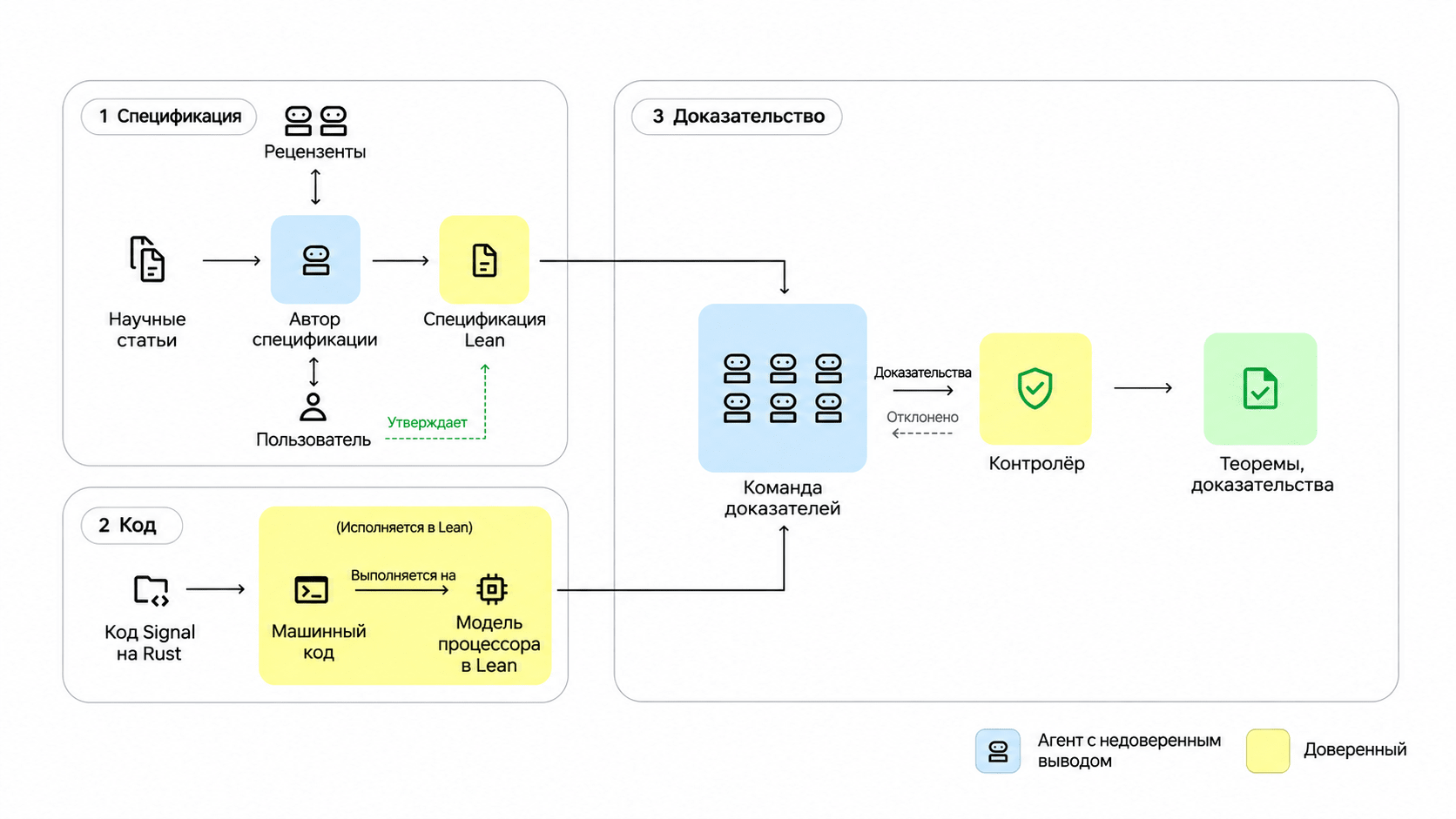
Google DeepMind introduced AlphaProof Code and used it to formally verify an implementation of the Signal protocol. Formal verification does not test code on examples; it mathematically proves that it does what it promises for any input. Humans and models wrote the security properties as Lean specifications, while Gemini Carbon-powered agents wrote the proofs themselves: about 6.5 million lines on top of roughly 26,000 lines of trusted specifications and a description of AArch64 machine code, according to the authors' paper. They verified the binary of unmodified libsignal, built with a standard compiler, rather than the Rust source: the quantum-resistant PQXDH handshake and Triple Ratchet. Among the properties proved were forward secrecy and post-compromise security, meaning that messages remain protected both before and after a temporary device compromise. The agents themselves flagged about 1% of the code for human review, Lean checked the rest, and the entire effort took four weeks.
To make sure the system could distinguish correct code from broken code, the researchers reintroduced two long-fixed bugs into an isolated copy and, in both cases, obtained a machine-checked proof that the resulting version was insecure. No new vulnerabilities were found in the verified parts, WIRED reports. DeepMind published the specifications and proofs on GitHub. Three weeks ago, I wrote about how Anthropic and Theorem proved crash freedom for 239 entry points in OSS-Fuzz libraries, producing about 180 million lines of Rocq proofs. Google's line count is lower by a factor of tens, but this time the subject is a cryptographic protocol.
Stay curious.