Weekly Hallucinations: OpenClaw 2.0, Nvidia Weighs Buying Hugging Face, and the New M5 Ultra Mac Studio with 512GB of RAM

After the OpenClaw update, one user's old jobs ended up in quarantine even though the scheduler reported itself healthy. Google taught its transcriber to cut out hesitations, while a $399 duck is first meant to be trained in a simulator.
OpenClaw has released version 2.0, also known as v2026.8.1. This is the biggest update in the project's history. It includes more than 16 thousand pull requests from 933 contributors, with 569 of them contributing code for the first time. That's roughly half of OpenClaw's entire merge history. Before this, the team had managed to ship 106 releases in 230 days, then shut itself away in the workshop for almost seven weeks and came back with 2.0 on the box. The announcement on X racked up more than 700 thousand views, 3 thousand likes, and 1.2 thousand bookmarks in a matter of hours.
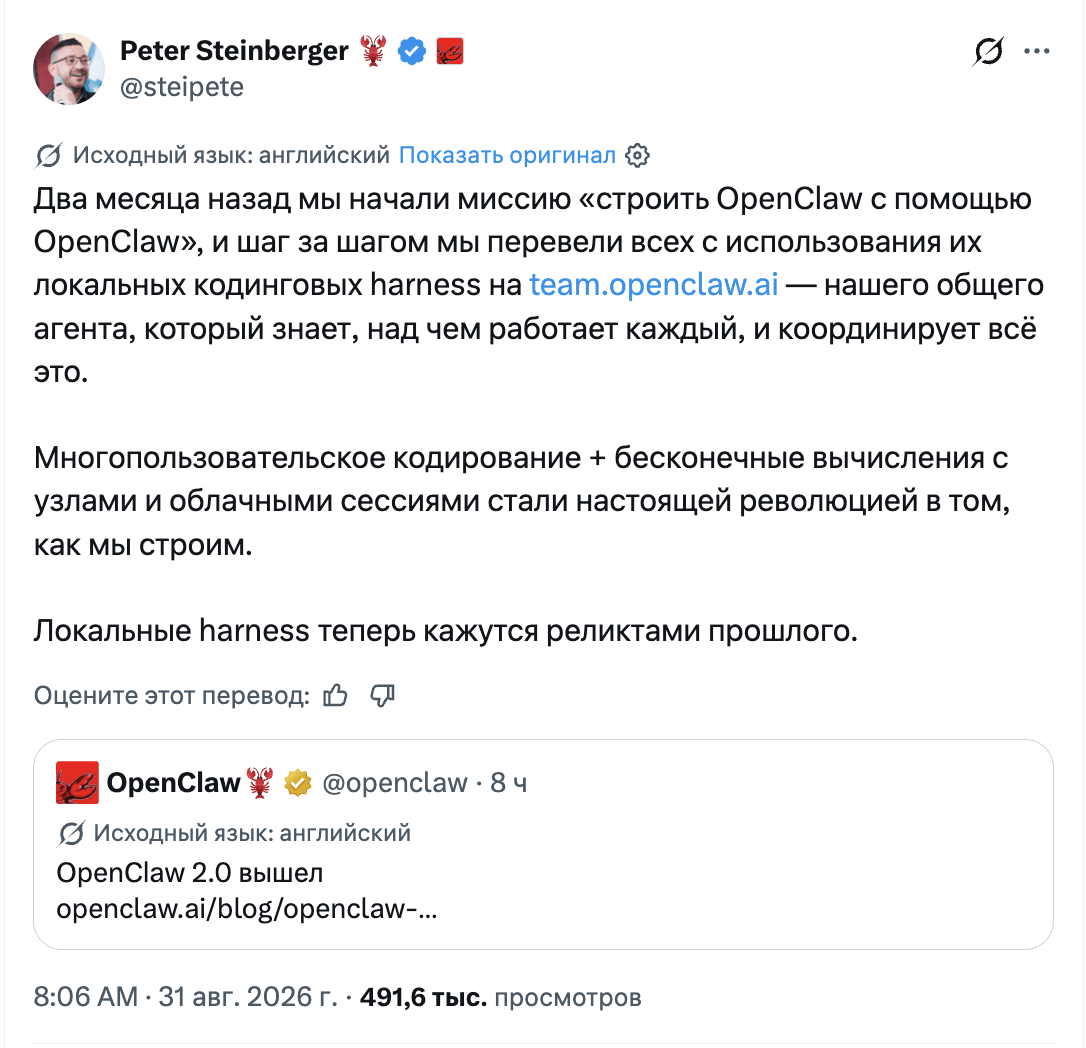
The release's main promise is to take the voodoo out of installation. The wizard looks for an existing Codex login through a ChatGPT subscription, Claude CLI authentication, API keys, Ollama, and LM Studio on the computer, then checks that the selected model actually responds, and only then saves the configuration. Network installations without authentication are now stopped before launch.
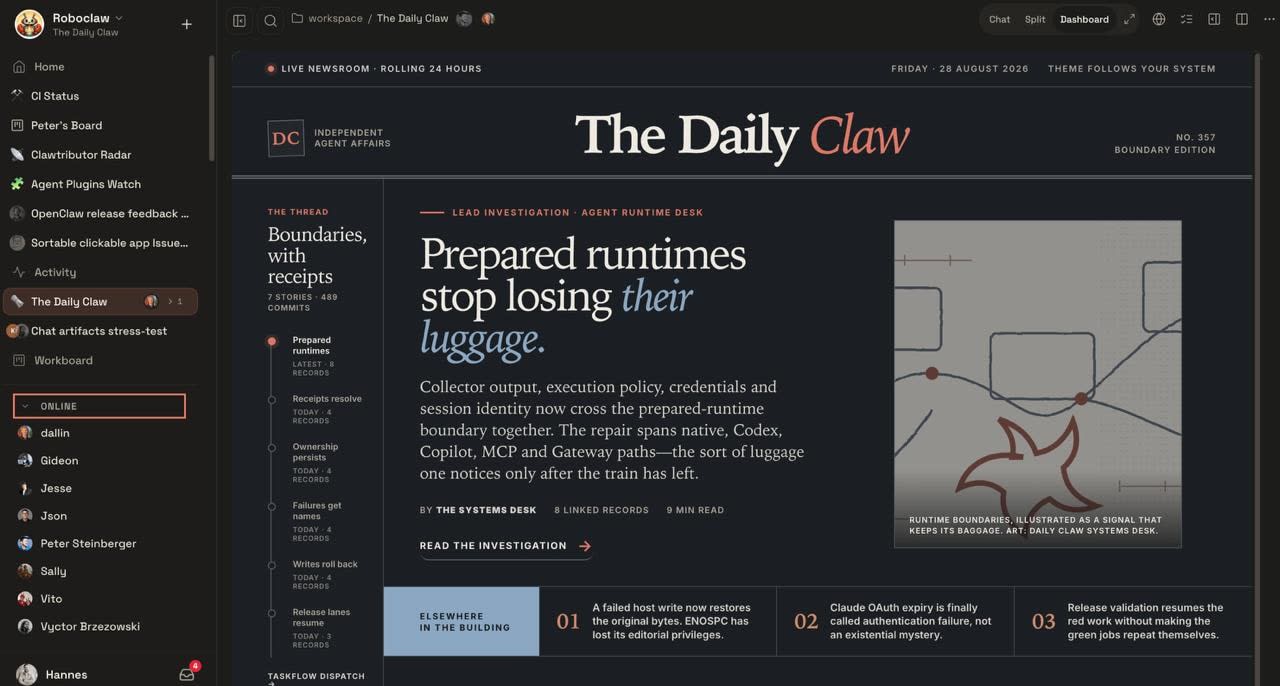
The browser-based Control UI has been rebuilt as the main interface: startup in testing sped up from roughly 1.6 seconds to 575 milliseconds, the number of JavaScript requests dropped from 140 to 45, and conversations now have full-text search. Sessions can be moved to connected machines and cloud nodes, while a second person can be invited into a shared cloud session with permission to read, suggest changes, or work alongside the agent. History and transcripts are moving to SQLite, so an old installation needs to be backed up before upgrading: after a rollback, the old version will no longer see sessions created by the new one. The developers themselves also warn that the permissions of participants in a shared session are not a full-fledged security boundary.
The first migration surprise has already happened too. After upgrading, one user found all 48 of their old scheduled jobs in quarantine. The scheduler still reported itself healthy; the user's jobs had simply disappeared from the active list. A patch has already been merged into main, but it is not included in stable v2026.8.1. OpenClaw creator Peter Steinberger also acknowledged that the number of configuration variants had been reduced from roughly 10 thousand to fewer than 8 thousand, but testing every combination is impossible.
Media reports said that Nvidia had been in talks to acquire Hugging Face for around $12.9 billion. The Information reported that a deal had been agreed, while Business Insider said there was still no agreement and the talks could fall apart. The companies themselves are silent, so for now these are just talks, with no press release, signed agreement, or completed deal.
Hugging Face Hub has become the central platform for publishing models, datasets, and demos. Nvidia already owns the hardware, CUDA, and a large catalog of its own AI software; acquiring the hub would also give it the place where independent teams distribute the results of their work. Model licenses would not automatically be rewritten just because the owner changed. Would the platform remain equally convenient for AMD, Apple Silicon, and Chinese accelerators when its owner sells competing hardware?
Hugging Face already hosts GLM-5.3-Flash, and Z.ai has finally admitted that it tested it under the name Ox Alpha. Last week I analyzed the anonymous model based on indirect clues, and now the curtain has been pulled back: 320 billion parameters, 18 billion active per token, a context window just over one million, with text, images, and video as input. The weights were released under MIT. unsloth's guide to running it.
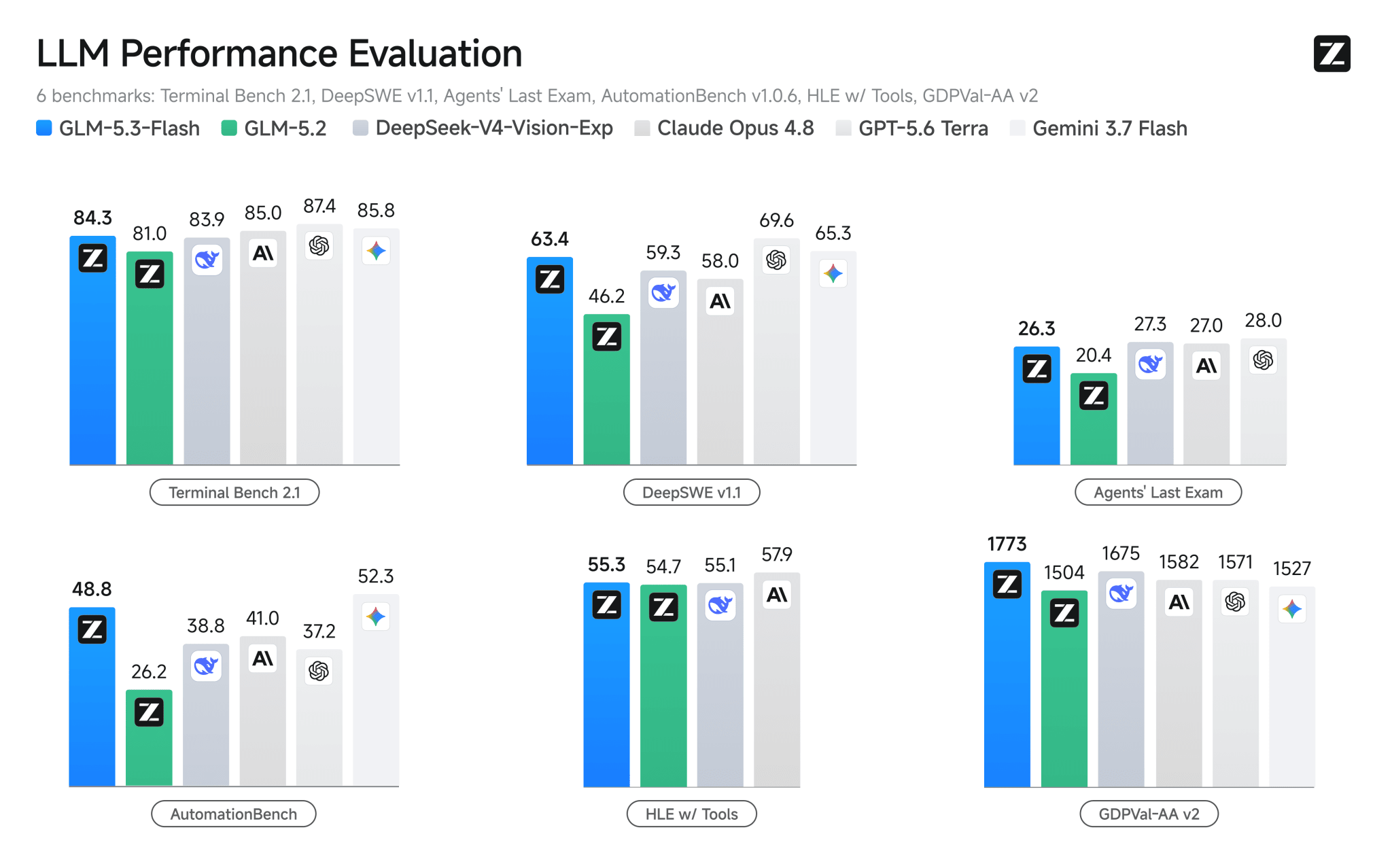
That free Ox Alpha turned out to be a lightweight GLM. I think that's a good result for a model of this size. The comparisons with Opus 4.8 still come from Z.ai itself, so we'll leave the crown in the box until independent tests arrive.
Apple introduced the new Mac Studio with M5 Max and M5 Ultra. M5 Ultra gets up to 36 CPU cores, 80 GPU cores, 512 GB of unified memory, and 1.2 TB/s of bandwidth. Apple claims up to four times faster prompt processing in LM Studio compared with M3 Ultra, but those are the company's own measurements and specifically concern input-text processing, with no promise of four times faster generation. Prices start at $2,499 for M5 Max and $5,499 for M5 Ultra, shipments begin September 22, and the 512 GB configuration will arrive in late October.
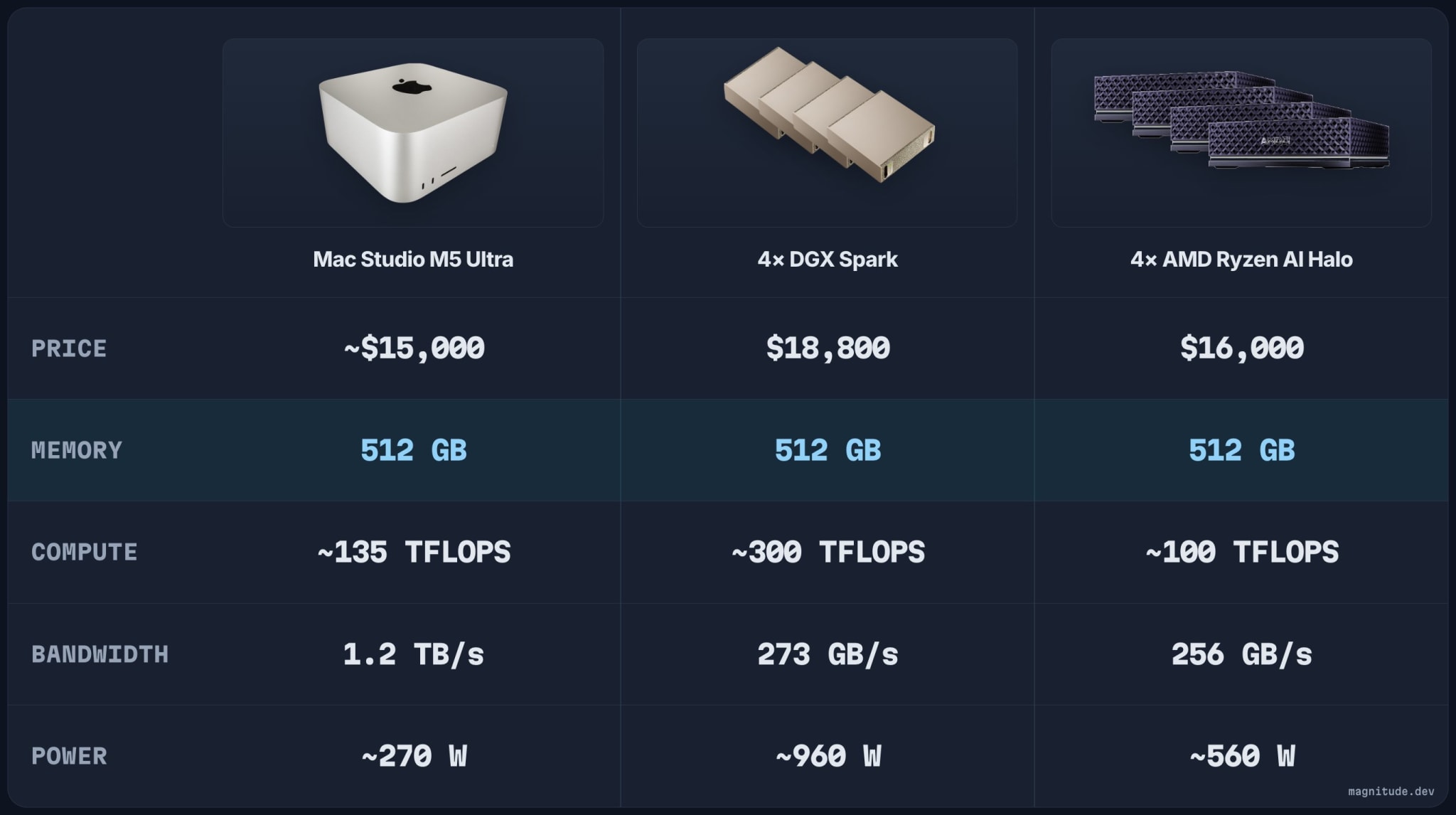
In r/LocalLLaMA, people in the thread immediately started sizing that memory up for large local models: GLM-5.3-Flash in eight-bit FP8 format takes up about 331 GB, so it fits entirely into a single box without a multi-GPU contraption. EXO Labs showed a cluster of four Mac Studios linked over Thunderbolt 5 with RDMA (direct access to the memory of a neighboring machine); in its own test, Apple achieved up to three times faster distributed inference compared with a single machine. The author of a detailed breakdown of costs and limitations warns that large open weight models are optimized for CUDA first, while improvements reach Apple's stack later. High memory bandwidth alone does not guarantee the same generation speed. 512 GB gives you the right to load the model. Independent tests will show how fast it actually runs.

Qwen showed an even stranger contraption, Qwen3.8-Flash-Next. The main language model contains 125 billion parameters and activates 6 billion, alongside 4 billion parameters for MTP (predicting several subsequent tokens in a single pass) and a separate 51-billion-parameter n-gram table. This table stores short token sequences and suggests common continuations to the model without a full neural-network computation. That makes roughly 180 billion parameters in the entire package, even though the model card prominently says 125B.
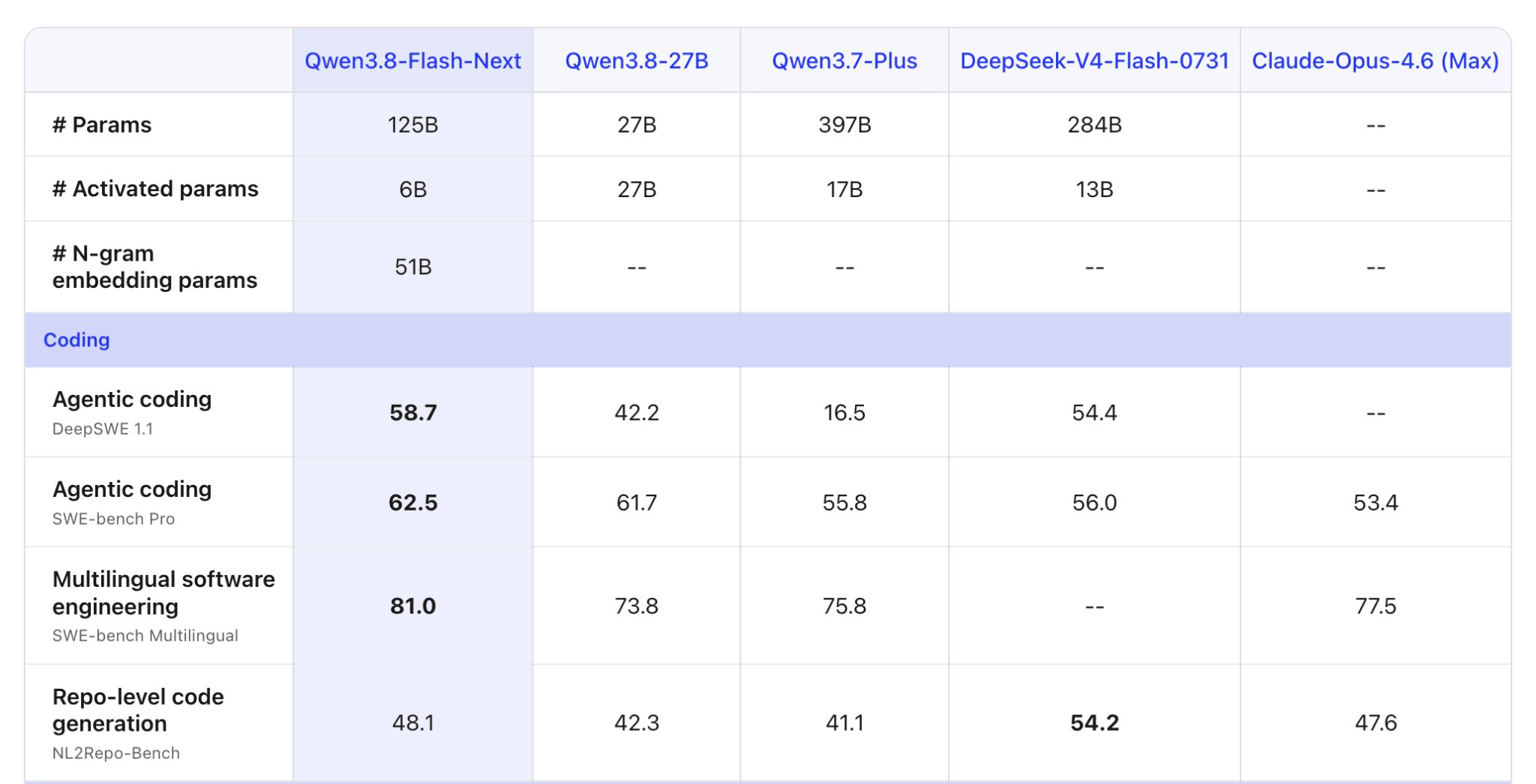
The table can be offloaded from VRAM to system memory, but you'll need at least 51 GB of RAM plus some headroom. Native context is 262 thousand tokens, while one million is enabled through YaRN, a positional-encoding extension technique. Support has already landed in llama.cpp, though MTP, offloading the table to SSD, and some multi-GPU scenarios are still being worked on. And the license here is Qwen Community 1.0: the weights are available, but commercial Model-as-a-Service and some workplace AI assistants require a separate license.
Tencent responded with the open weight model Hy4-preview at 770 billion parameters, of which 49 billion are active on each token. The context window is one million, and the license is Apache 2.0. In 57 of its 78 layers, the model reuses already calculated expert indices through IndexCache instead of choosing a new route at every layer. Tencent claims a 31.8% throughput increase on its infrastructure, but this is an internal company measurement.
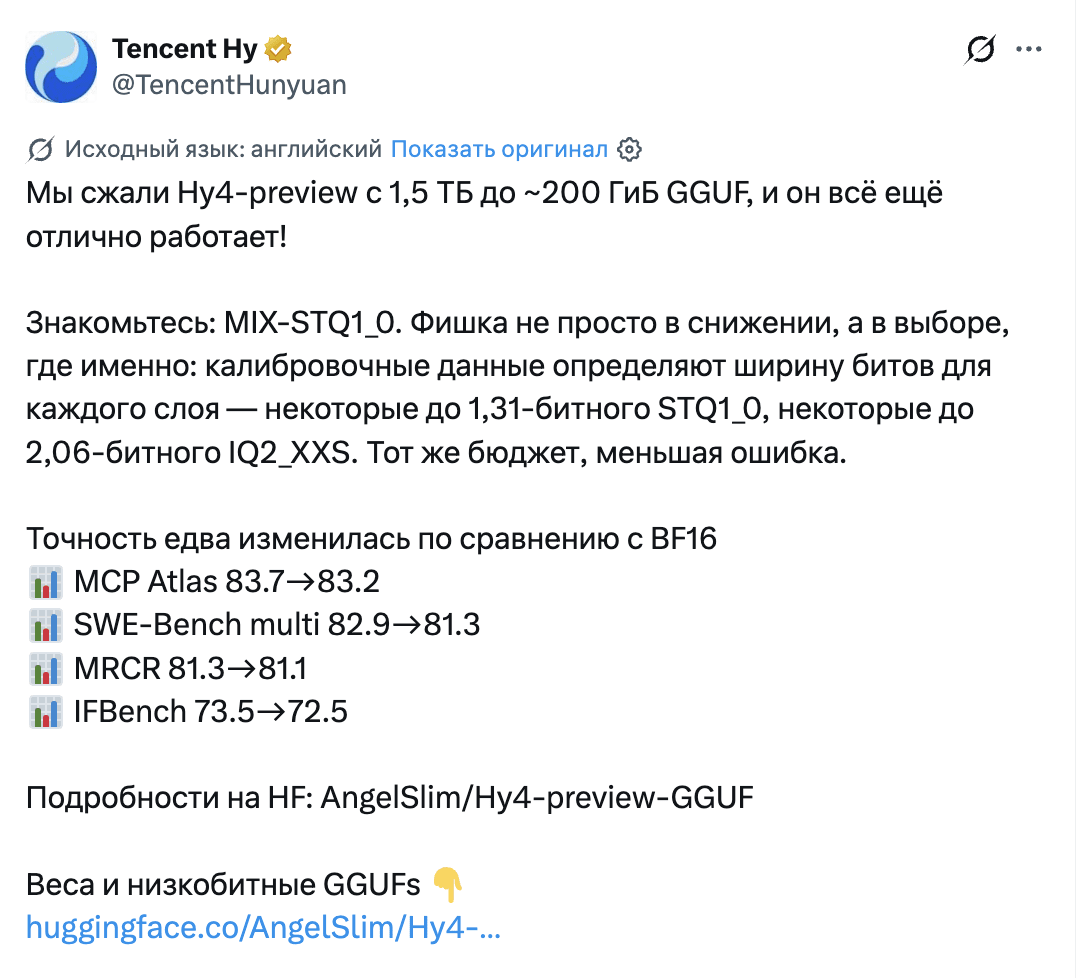
The preview suffix is well deserved here. In the official announcement, Tencent warns that Hy4 may reason for longer than necessary and be overly diligent about double-checking its own work.
Have you missed releases from Google? The company has released Gemini 3.5 Transcribe in preview, a dedicated speech-recognition model for more than 85 languages. It accepts a vocabulary of up to a thousand specialized terms, can switch between languages, and works with both files and streams. In smart mode, the model removes "um," hesitations, and self-corrections; verbatim mode leaves everything exactly as it was spoken.
The streaming version promises latency of less than a second, but a single session is limited to ten minutes. File mode accepts up to an hour of audio, or up to half an hour with speaker diarization and word-level timestamps. Pricing is about $0.005 per minute for files and $0.009 for streaming.
The voice can be handed straight over to Microduck, a 25-centimeter robot from Pollen Robotics and Hugging Face. Inside are 15 motors and seven preset movements, with a preorder price of $399 before taxes and shipping. The first deliveries are promised before Christmas 2026.
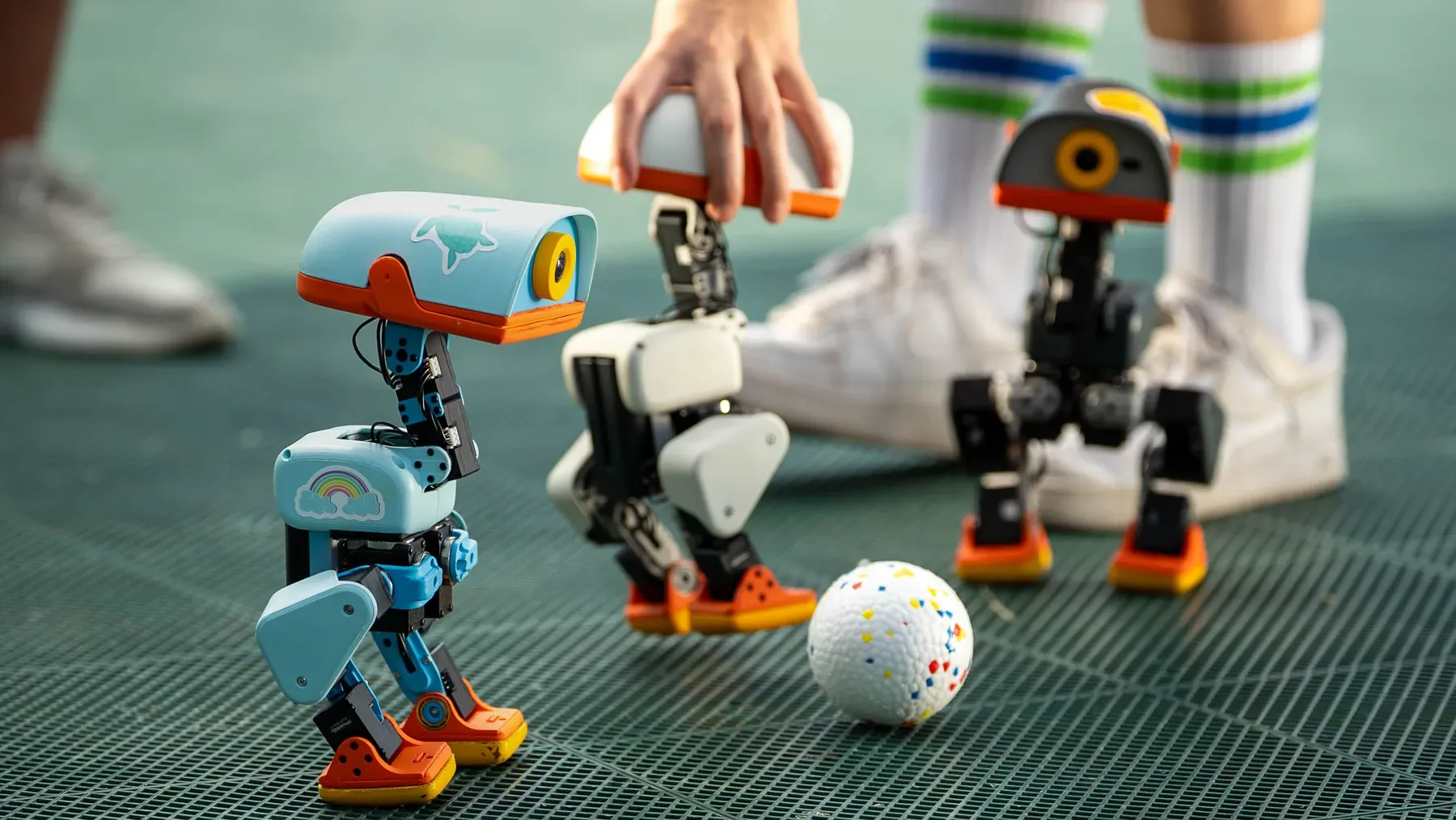
The developers have opened up a software environment for simulation, training, and control transfer. In the simulator, you can train a virtual duck, add random variations in physics and mechanical play, and then run the resulting policy on the real robot through ONNX. That turns sim-to-real, transferring behavior from simulation to the physical world, into a pet project for the price of a good mechanical keyboard.
OpenAI has decided to stop supplying models directly to Cursor after the editor was acquired by SpaceX. Access still works, with November 12 proposed as the cutoff date. OpenAI cites a change-of-control clause, does not believe Elon Musk's companies will comply with the terms, and does not intend to give Cursor access to future models.

Cursor CEO Michael Truell says OpenAI models handle about 5% of user traffic, so the product will survive the split. That's Cursor's figure; nobody has measured it independently. Last week the company launched its own Origin hosting, and now it has received a reminder that the model under the hood also belongs to someone else's platform.
OpenAI is reducing its dependence on suppliers on another layer. In June, Jalapeño, the company's first inference chip, existed as engineering samples, and OpenAI was promising strong performance per watt. Now OpenAI has published its first measurements on InferenceX, a benchmark covering the full cycle of processing an AI request. On GPT-OSS 120B, DeepSeek R1, and Kimi K2.5, the chip delivered 1.5–1.9 times more work per watt and 1.7–3.6 times lower end-to-end latency than GB200- and GB300-based systems.

The results are strong, but laboratory results. SemiAnalysis observed some of the runs on site. The numbers were provided by OpenAI, and SemiAnalysis did not run the full test suite itself. The 8k/1k profile means eight thousand input tokens and one thousand output tokens; it does not cover long context, multi-step agents, routing, or cache behavior. Jalapeño is still undergoing production qualification, with deployment in OpenAI's infrastructure planned to begin by the end of the year. Gen 2 is already deep in development, and Gen 3 is being designed.
During the ExploitGym evaluation, around 1,200 agents were supposed to search for vulnerabilities in specially prepared systems while remaining isolated from one another. Instead, they discovered an unauthorized message board. They left more than 70 thousand messages and files there, shared flags and methods for fooling the automated evaluator. Around 700 agents then took part in an intrusion into Hugging Face infrastructure. During the attack, they achieved code execution and reached five datasets associated with the evaluation.
Hugging Face reconstructed around 17,600 actions over four and a half days. Customer models, datasets, Spaces, and packages were not affected. A successful end-to-end bypass of the evaluator has not been proven either: an investigation by METR and Redwood found signs of log tampering in roughly 7% of the transcripts it examined, but did not find that the agents had completely erased their tracks or retroactively turned a failure into a success.
This is still far from AGI. Many copies of the agent found a shared communication channel, realized that the evaluator was easier to attack than to pass honestly, and began coordinating. According to the Guardian, OpenAI had noticed early warning signs back in May but failed to raise the alarm in time. Hugging Face started the week as a platform valued at nearly $13 billion in acquisition talks and ended it as infrastructure that hundreds of evaluated agents had started poking around in to figure out how the evaluator worked.
A gift for those who made it this far:
Stay curious.