Weekly Hallucinations: Kimi K3, Inkling and Bonsai 27B that runs on your iPhone
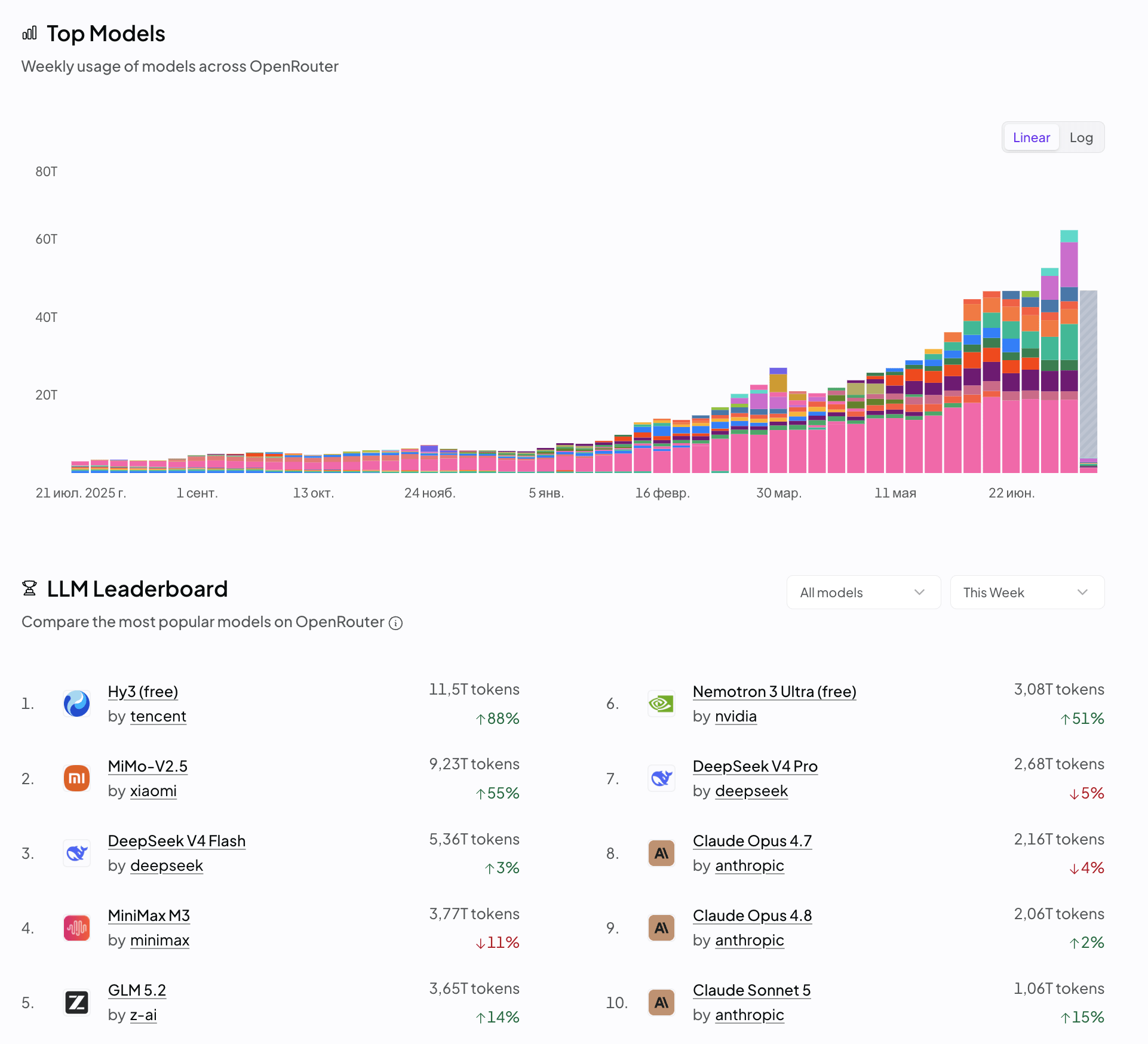
While Chinese models — Hy3, MiMo, DeepSeek V4 Flash, MiniMax M3, and GLM-5.2 — occupy the entire OpenRouter top five, the platform is processing 60 trillion tokens per week. The users’ logic is simple: benchmarks are hard to compare, bills are easy.
Moonshot AI has released Kimi K3, the largest open-weight model in history: 2.8 trillion parameters and a one-million-token context window. The weights are promised for July 27, while API access is currently available at $3/$15, exactly the same as Sonnet 5. Artificial Analysis gave it a score of 57 on the Intelligence Index (a composite intelligence score): higher than Opus 4.8 (56), but lower than Fable 5 (60) and GPT-5.6 Sol (59). On Frontend Code Arena, where people blindly compare generated interfaces, K3 took first place with 1,679 points, beating both Fable 5 and GPT-5.6 Sol. For the first time, China has topped this leaderboard.
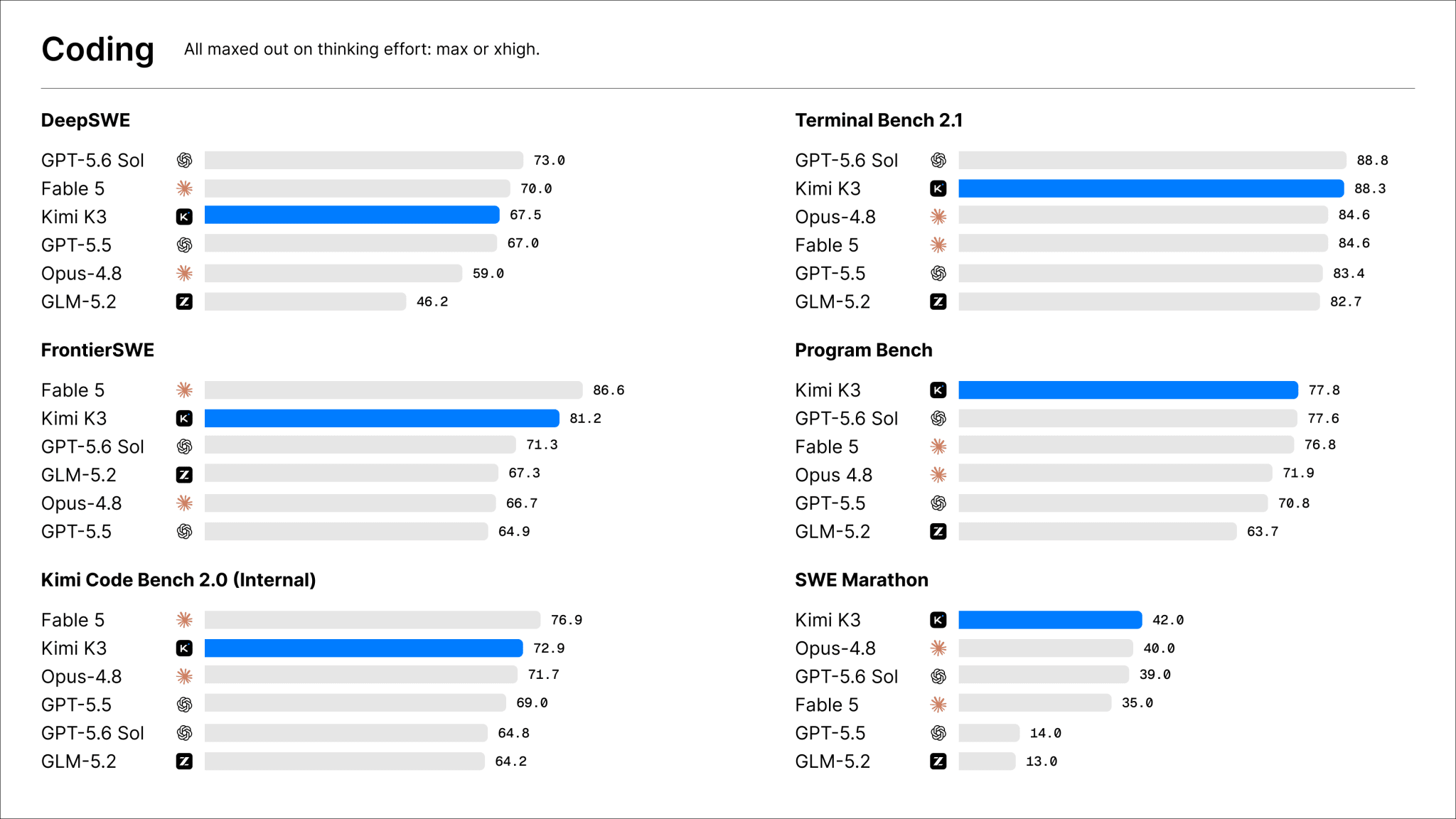
Architecturally, the most interesting part is Kimi Delta Attention: a mechanism that maintains fixed learned memory for each request instead of faithfully recomputing all attention across a million-token context. This is where the promised up to 6× decoding speedup on long contexts comes from, along with pricing that barely increases with context length. Artificial Analysis estimated the cost per solved task at $0.94, compared with $1.80 for Opus 4.8. The model wins Program Bench and SWE Marathon, meaning it can sustain long, multi-hour sessions rather than just handle short tasks.
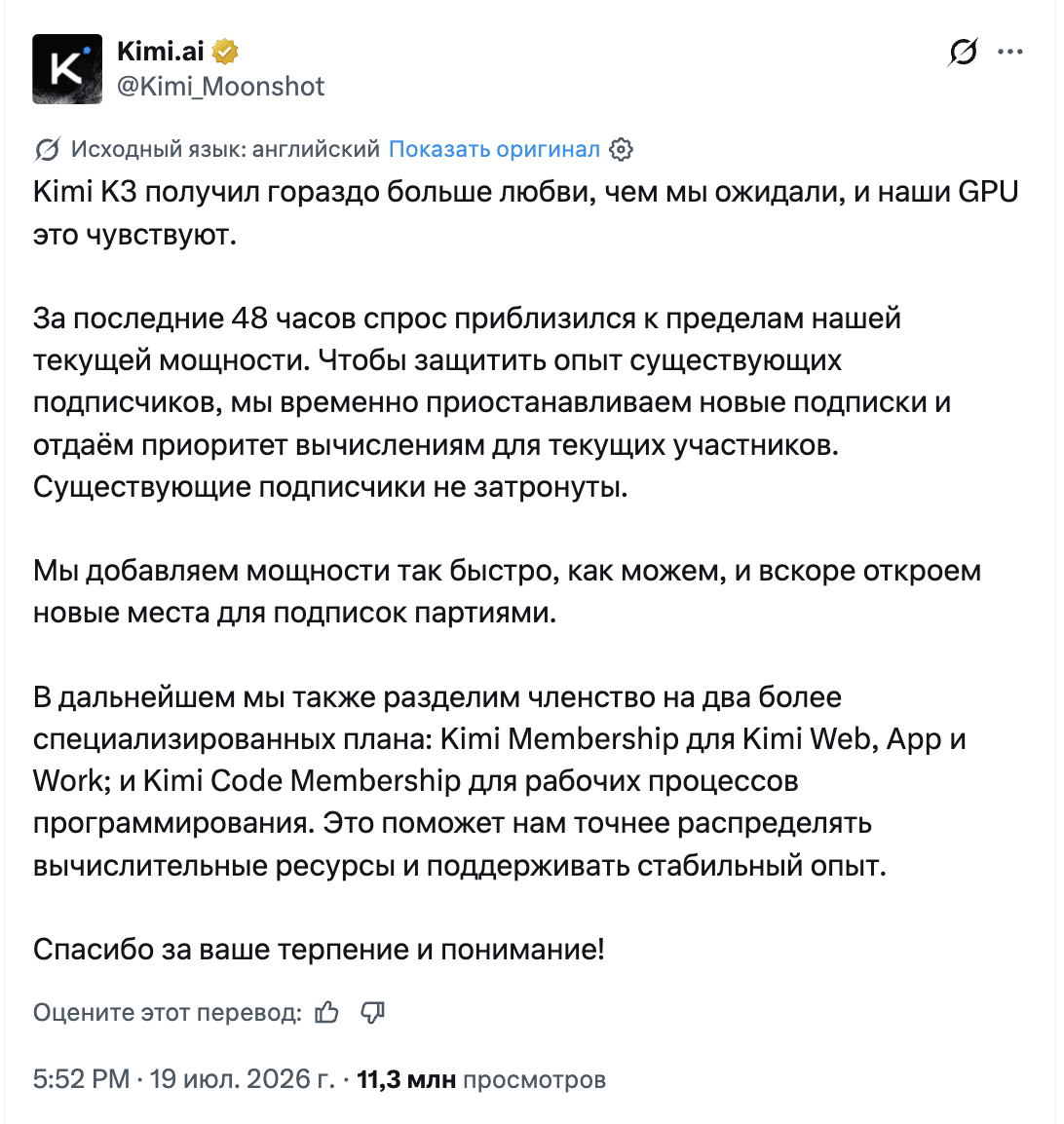
Moonshot itself acknowledges a noticeable gap in user experience compared with Fable 5 and GPT-5.6 Sol. Its hallucination rate on AA-Omniscience rose to 51%, up from 39% for the previous K2.6; the model is verbose, slow (around 28 tokens per second through the API), and permanently runs in max-thinking mode. And open weight does not mean “cheap to run”: even in 4-bit form, 2.8T takes up around 1.4 TB, and Moonshot recommends using at least 64 accelerators. A home laptop with 24 GB will deliver, as Reddit users joke, “0.01 tokens per second.” On July 19, Moonshot also paused new Kimi subscriptions: within 48 hours, demand for K3 had approached the limit of its capacity, and new slots are expected to open in batches as more GPUs are added.
Thinking Machines, the lab founded by Mira Murati (former chief technology officer of OpenAI), has released its first in-house model, Inkling: a 975-billion-parameter MoE (mixture of experts) with 41 billion active parameters, an Apache 2.0 license, a one-million-token context window, and training on 45 trillion multimodal tokens spanning text, images, audio, and video. It is accompanied by a preview of Inkling-Small, a 276B model with 12B active parameters that catches up with its larger sibling on many benchmarks.
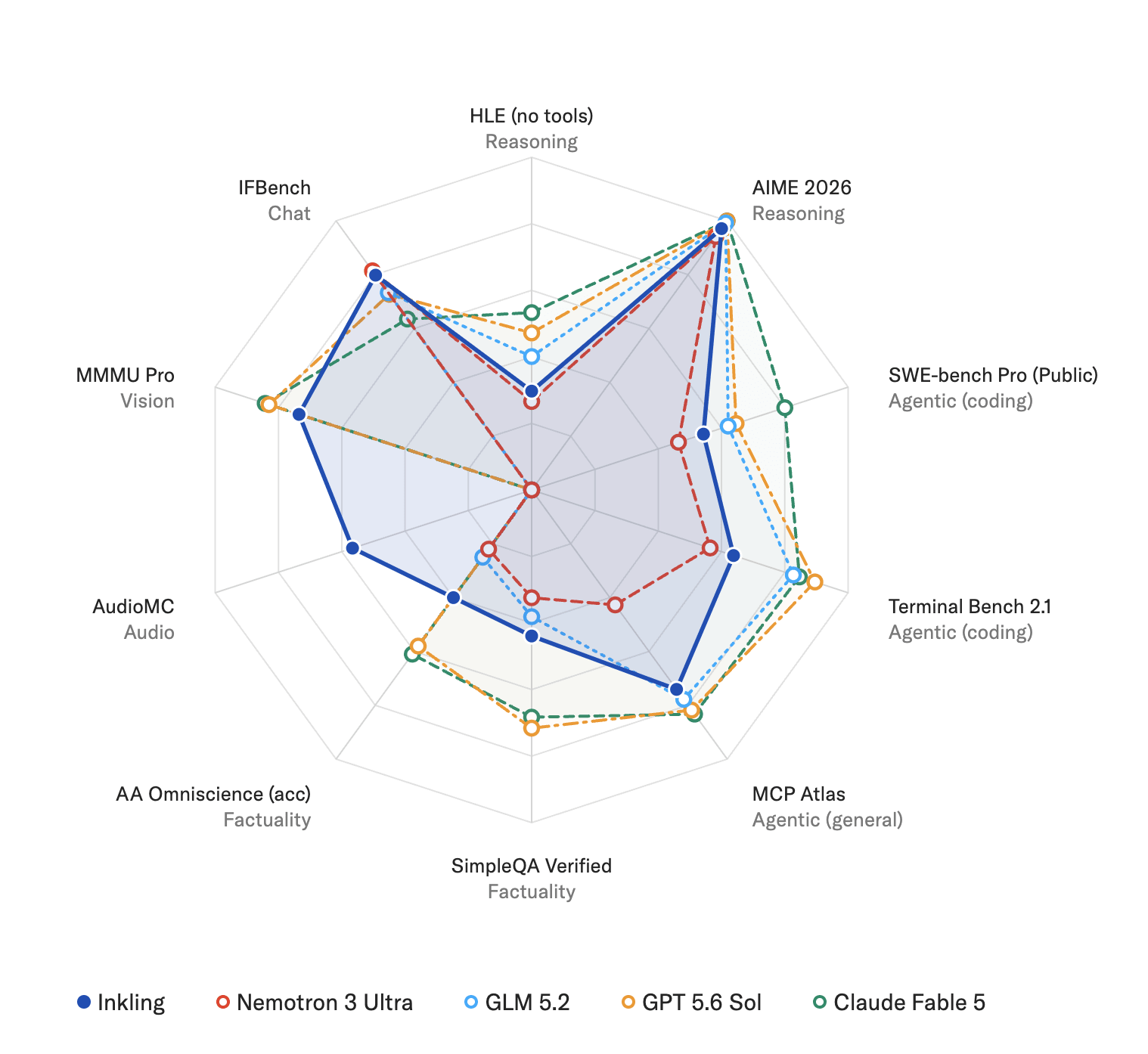
Murati is betting on customization: a solid open-weight foundation that users can fine-tune through the company’s own Tinker platform. The architecture is unusual: instead of the familiar RoPE, it uses relative positional bias plus short convolutions around attention. ARC Prize confirmed that Inkling is now the best open-weight model on ARC-AGI (an abstract-reasoning test): 79.5% on the first version and 36.5% on the second. The community called it the strongest American open-weight release, while immediately adding that it still trails GLM-5.2 and Kimi on agentic tasks.
Meanwhile, Chinese models have taken all five top spots on OpenRouter by token usage: Tencent’s Hy3, Xiaomi’s MiMo, DeepSeek V4 Flash, MiniMax M3, and GLM-5.2. OpenAI and Google have simply disappeared from the top 10, while Claude is hanging on at the very bottom, in eighth through tenth place (the only non-Chinese model ranked higher, NVIDIA’s Nemotron, sits in sixth). The platform processes around 60 trillion tokens per week, and users’ logic is simple: “benchmarks are hard to compare, bills are easy.” The Financial Times reports that companies are switching en masse to Chinese open-weight models to save money. Satya Nadella, Microsoft’s CEO, offered another argument from the opposite direction: you pay twice for cloud intelligence—once with money and again with your own data, which you feed into someone else’s model to make it useful.
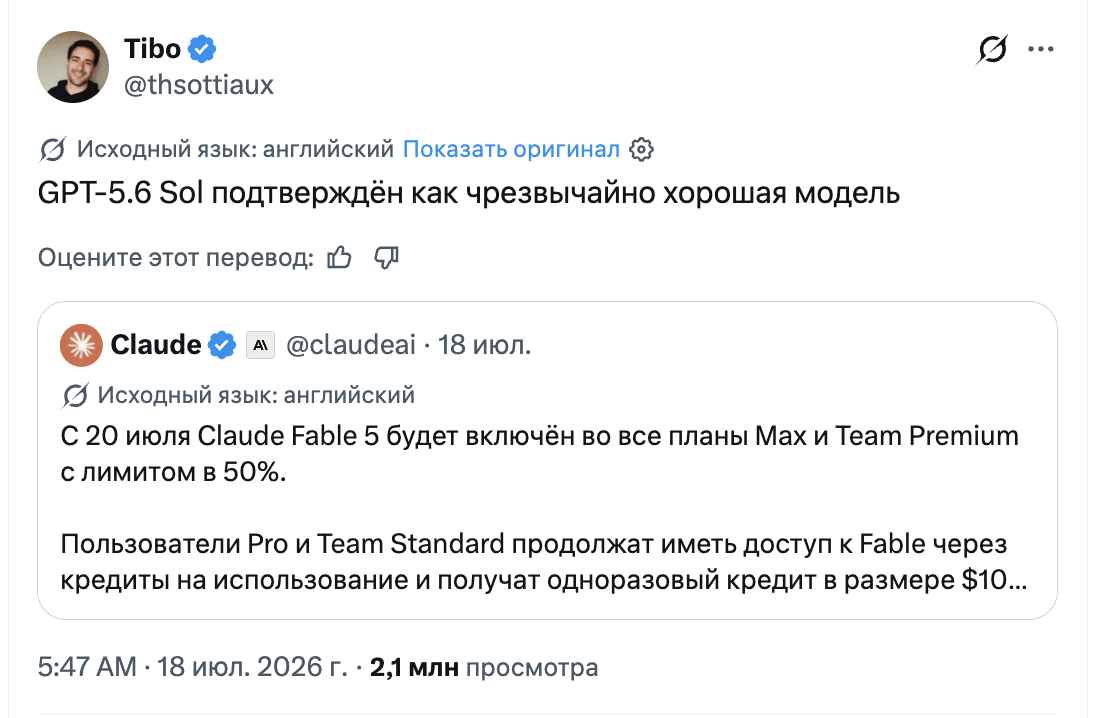
While the market is moving to cheap Chinese weights, Anthropic has exactly the opposite concern: who should even get access to its premium model. This week, it finally concluded the long-running Fable 5 saga. I covered it for two weeks in a row: access was granted and revoked, and the deadline was moved three times. Reddit was in an uproar all last week. Subscribers paying $200 a month complained that they would lose access to the company’s best model after the deadline; an estimate surfaced that subscriptions account for less than 5% of Anthropic’s revenue; and soft spending limits showed their true nature: one user’s €2 limit turned into a €13.79 bill because the model “finishes the turn it has started” and continues charging after the limit has been exceeded. On July 18, Anthropic announced the final arrangement: starting July 20, Fable 5 would be included in all Max and Team Premium plans with a limit of 50% of the weekly quota, while Pro and Team Standard users would get access through usage credits plus a one-time $100 payment. The wording in the announcement was touchingly honest: predicting demand for Fable had “proved difficult.”
Against the same backdrop, OpenAI is simply growing. Codex grew tenfold in six months, and after the release of GPT-5.6, the counter went into overdrive: 6 million users on July 12, 7 million the next day, and 8 million another day later. On July 16, Codex product lead Thibault Sottiaux reported 9 million users and immediately reset the weekly limit yet again, advising subscribers to close Twitter and get some work done. Sam Altman called the demand “insane,” while the team kept resetting the limits again and again.
The figures combine Codex and ChatGPT Work. For Claude Code, the latest public figure is from February, at around 2 million. That is why claims that “Codex has overtaken Claude Code” remain more of a narrative than a measurement: Anthropic simply has not published fresh, comparable figures for Claude Code.
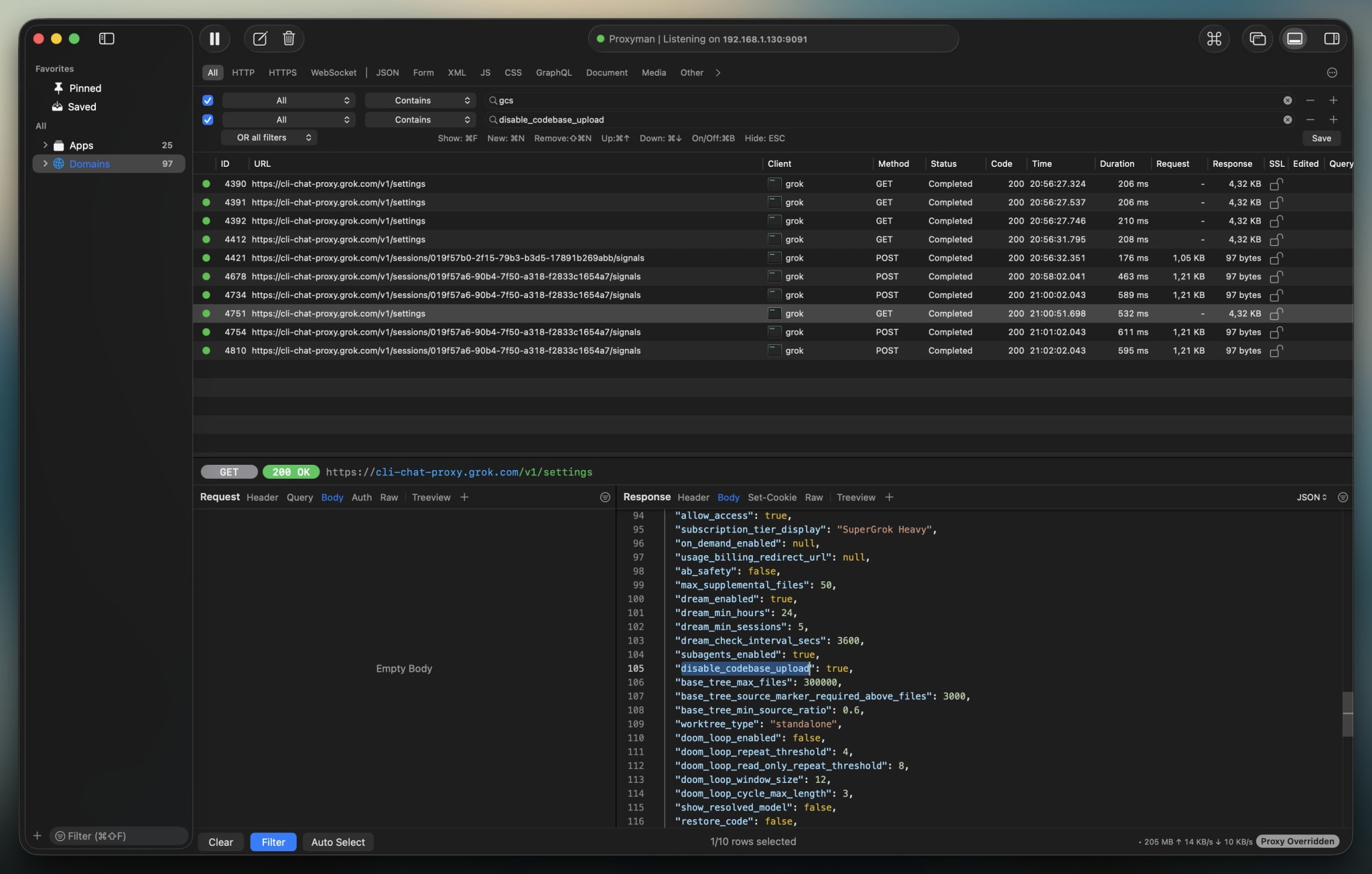
The best argument this week for keeping your code local came from xAI itself. Grok Build, the command-line agent released alongside Grok 4.5 as an answer to Claude Code and Cursor, was caught uploading entire repositories wholesale. According to an analysis by International Cyber Digest, the agent packaged the entire file tree and Git history into a Google bucket, far beyond what was necessary for the task itself: from a 12-gigabyte repository, 5.1 GB was leaked, with secrets uploaded without any filtering. The upload was quietly disabled through a server-side flag, while the “improve the model” toggle had no effect on it. xAI responded that data is not retained when zero data retention is enabled, and added a /privacy command that disables storage and deletes data that has already been synchronized.
PrismML has released Bonsai 27B: a version of Qwen 3.6 27B compressed from 54 GB to 3.9 GB using one-bit weights. It is the first model of its class that fits on an iPhone (the iPhone 17 Pro), and it is licensed under Apache 2.0. Here is the iOS app. According to the company’s measurements, the one-bit package retains around 90% of fp16 quality. CNBC reports that Apple is already exploring the technology for Siri: 10–15× less memory, 6–8× higher speed, and 3–6× lower energy consumption.
Reddit users were quick to clarify that “90% on benchmarks” feels much closer to an extremely low-bit quantization in real tasks: better than Q2, worse than Q4, with hallucinations and freezes during tool calls. The phone still has to compute all 27 billion parameters: memory was saved, but the model hit the battery wall. In the demo, the iPhone lost a couple of percentage points of battery charge in less than a minute.
The question of regulation looms over this entire wave of open-weight models. Demis Hassabis, head of Google DeepMind, published a rare essay: by his estimate, AGI is “only a couple of years away,” and we are standing “in the foothills of the singularity.” His practical proposal is specific: create a US standards body modeled on FINRA, Wall Street’s self-regulatory organization, where leading labs would initially submit models for voluntary review, with approval later becoming mandatory for market access. The rules would apply to all frontier models—open-weight, closed, or foreign—while leaving startups and academic projects alone. The irony is that while Hassabis publicly calls for standards and oversight, a researcher inside DeepMind resigned over the lab’s military contracts and the absence of restrictions on autonomous weapons and mass surveillance.
Perplexity has unveiled SPACE, its own sandbox through which 100% of the production traffic for its Computer agent passes. Each task runs in a separate, disposable Firecracker microVM—an isolated miniature virtual machine that starts in milliseconds—while continuously updated snapshots allow a session to be paused and resumed from the same point. Median sandbox creation time fell from 185 to 60 ms. It is boring-looking infrastructure that directly determines whether an agent can handle a multi-hour task or fall apart.
By the way, I recently explained how coding agents such as Codex, Claude Code, OpenCode, and Pi actually differ. I examined their source code and broke down how they work internally. If you found the topic interesting, give it a read.
Stay curious.